


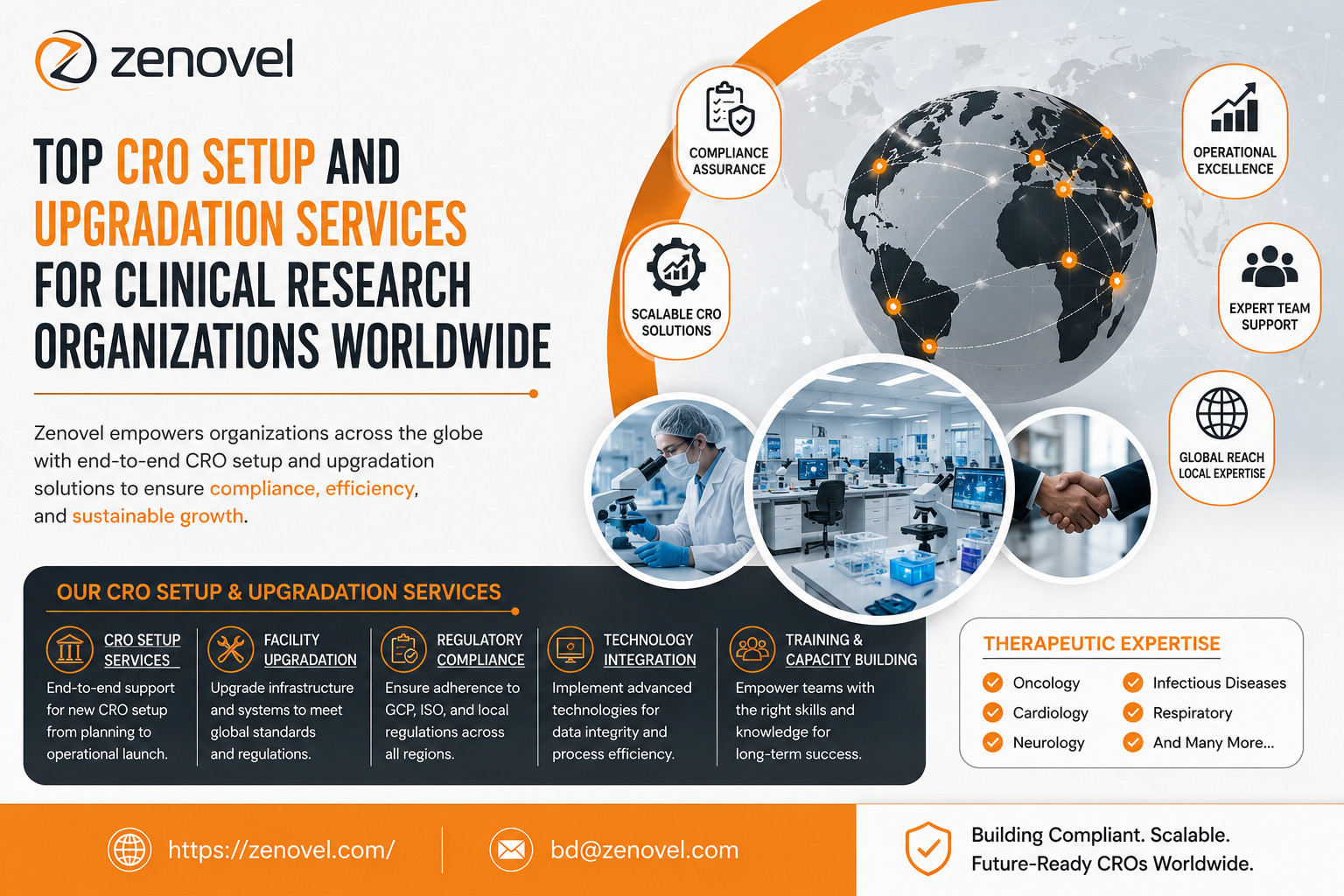
Top CRO Setup and Upgradation Services for Clinical Research Organizations Worldwide
The global clinical research landscape is evolving rapidly. Driven by stringent multi-regional health authority demands, complex trial designs (such as decentralized and adaptive studies), and strict data integrity expectations, Clinical Research Organizations (CROs) worldwide are under immense pressure to modernize.
Whether launching a brand-new research center or scaling an existing bioanalytical or Phase I–IV clinical unit, CROs need robust compliance infrastructure. Selecting the right CRO Setup and Upgradation Services determines whether a trial center can seamlessly attract international biopharmaceutical sponsors and pass inspections by top agencies like the US FDA, EMA, MHRA, and WHO.
1. Core Pillars of Modern CRO Setup Services
Building a GCP-compliant CRO from the ground up requires far more than acquiring physical space. It demands a strategic framework that integrates facility architecture, regulatory registration, and digital systems.
-
Infrastructure & Facility Engineering: Designing specialized clinical wards, intensive care monitoring setups (ICUs), phase I clinical units, and high-throughput bioanalytical laboratories that satisfy regional building codes and international GxP standards.
-
Quality Management System (QMS) Design: Constructing a risk-based QMS that incorporates local and international standards, customized Standard Operating Procedures (SOPs), clear organograms, and corrective action mechanisms (CAPA).
-
Regulatory Registration & Local Accreditation: Aligning early-stage operations with national registration frameworks. For example, ensuring proper listing in regulatory platforms like Peru's REPEC system or equivalent national health authority registries before accepting global protocols.
-
Workforce Readiness & Continuous Training: Establishing dedicated training plans covering Good Clinical Practice (GCP), Good Laboratory Practice (GLP), human subject ethics, and protocol-specific execution.
2. Strategic Upgradation: Modernizing Existing CRO Infrastructure
For established research organizations, upgrading facility capabilities is essential to unlock multi-market clinical trials and increase operational speed. Upgradation services focus on transforming legacy processes into agile, audit-ready operations.
High-Impact Upgradation Vectors
-
Paperless System Transition: Moving from manual, paper-heavy documentation to 21 CFR Part 11 and EU Annex 11 validated systems, such as Electronic Data Capture (EDC) and electronic Trial Master Files (eTMF).
-
Risk-Based Monitoring (RBM) Alignment: Integrating ICH E6(R2)/(R3) risk management principles to focus oversight on critical data points and human subject safety.
-
Multi-Jurisdictional GAP Audits: Conducting systematic GAP assessments to benchmark operational readiness against global standards (FDA, EMA, TGA, WHO) before real regulatory inspections occur.
-
Bioanalytical & PK-Stat Enhancements: Upgrading analytical equipment software, method validation protocols, and pharmacokinetics/statistical capabilities to support complex BA/BE studies.
3. Spotlight on Emerging Markets: CRO Setup and Upgradation Services in Peru
Latin America has become a key destination for global clinical trials, with Peru standing out due to its diverse patient population, centralized health authority oversight, and established hospital networks. However, conducting compliant research in Peru requires adherence to strict local frameworks enforced by the National Institute of Health (INS) via the Dirección de Investigación e Innovación en Salud (DIIS) and the National Authority for Pharmaceutical Products (ANM/DIGEMID).
Executing CRO Setup and Upgradation Services in Peru involves navigating specific regulatory mandates:
-
REPEC Registration: Every CRO operating in Peru must maintain active single-time registration and updated documentation in the Registro Peruano de Ensayos Clínicos (REPEC).
-
Ethics & Institutional Coordination: Establishing formal selection and training procedures for local clinical investigators and ensuring protocol approval from accredited Institutional Research Ethics Committees (CIEIs).
-
Digital Safety Compliance: Upgrading local CRO safety reporting systems to align with the INS REPEC v2.0 platform requirements for immediate SAE tracking.
CROs in Peru that invest in expert setup and modernization services effectively position themselves as reliable, high-quality regional hubs for international biopharmaceutical sponsors.
4. Operational Checklist for Global CRO Modernization
Before launching or expanding a clinical research facility, review this core compliance checklist:
-
Regulatory Strategy: Are operational SOPs mapped to regional regulations (e.g., INS in Peru, USFDA, EMA, MHRA)?
-
Quality Assurance: Is there an active GAP audit plan to detect and resolve compliance risks in advance?
-
Data Integrity: Do all IT platforms strictly adhere to ALCOA+ principles and e-signature validation guidelines?
-
Archival Systems: Are secure physical and digital archiving protocols in place for multi-year regulatory retention?
-
Inspection Readiness: Have key staff undergone mock audit simulations to prepare for official health authority inspections?
5. Partnering with Zenovel for Global CRO Excellence
Establishing or upgrading a research organization requires deeply specialized regulatory intelligence and practical operational expertise.
Zenovel brings extensive international experience across more than 30 countries, supporting Clinical Research Organizations at every phase of maturity. From customized SOP generation, structural layout planning, and risk-based QMS implementation to mock audits, IT system validation, and staff training, Zenovel helps CROs achieve sustainable, audit-ready operational excellence worldwide.

 English
 French
 Spanish
 Portuguese
 Deutsch
 Turkish
 Dutch
Dutch
 Italiano
 Russian
 Romaian
 Portuguese (Brazil)
 Greek
Greek
 ไทย
ไทย