


Best Electric Car for Daily Driving in Nepal: A Practical Buyer's Guide
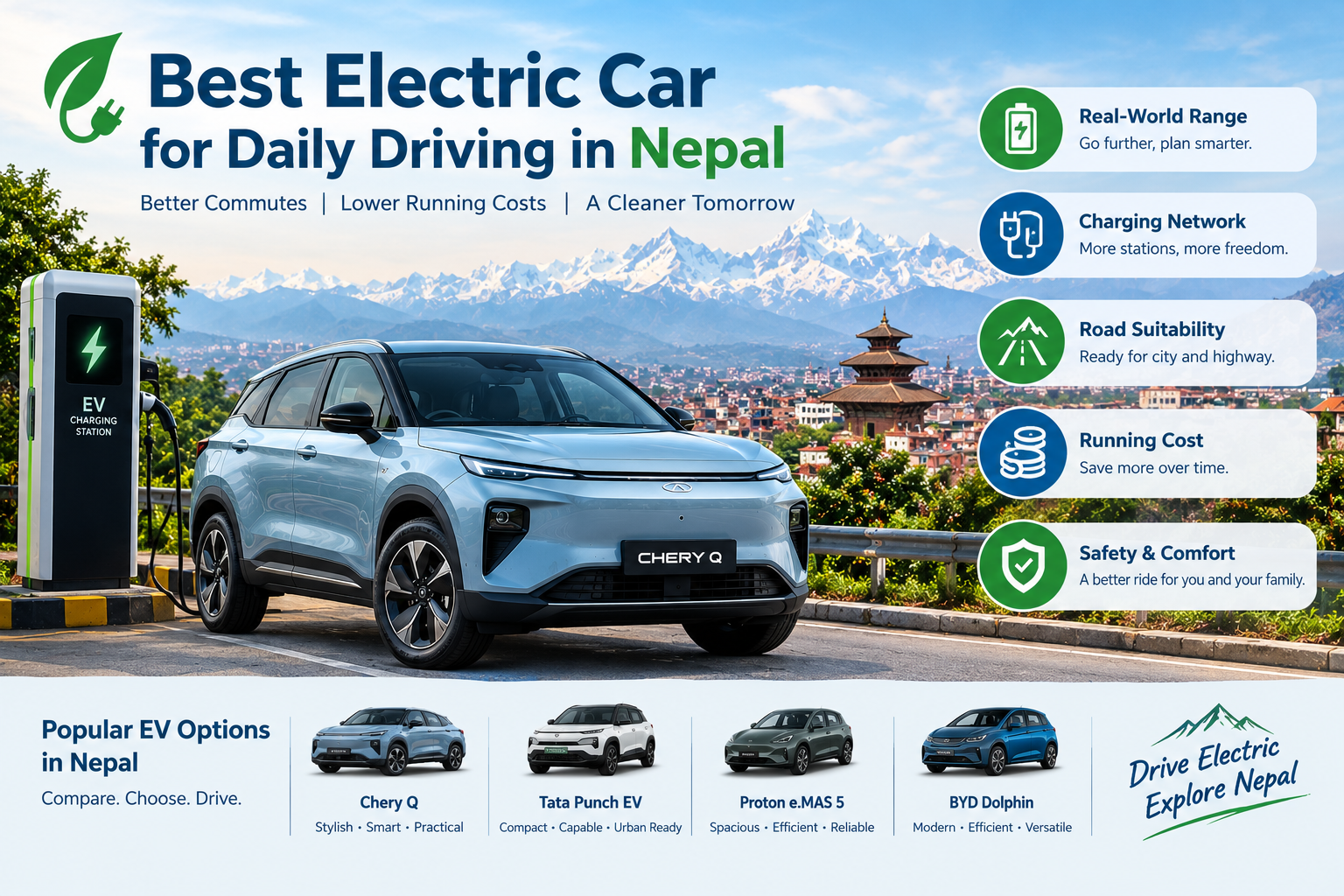
Electric vehicles are becoming a popular choice for everyday transportation in Nepal. From navigating Kathmandu's busy streets to commuting between home and work in cities such as Pokhara, Bharatpur, and Butwal, more drivers are considering electric cars as an alternative to petrol and diesel vehicles.
However, choosing the electric car for daily driving in Nepal involves more than comparing battery capacity or advertised driving range. A suitable EV should offer comfortable seating, manageable dimensions, reliable charging options, practical ground clearance, and reasonable ownership costs.
With several electric car brands and models available in the Nepalese market, buyers have more options than ever. Understanding which features matter most can help you select an EV that fits your daily routine and long-term budget.
Why Are Electric Cars Suitable for Daily Driving in Nepal?
Daily commuting often involves short journeys, traffic congestion, frequent stops, and limited parking space. These conditions make electric vehicles worth considering, particularly for drivers who have convenient access to charging.
Unlike conventional petrol vehicles, EVs use electric motors and battery packs to power the wheels. They do not require engine oil changes, and their regenerative braking systems can recover some energy during deceleration.
For people who drive regularly within urban areas, these characteristics can offer several practical advantages.
Lower Everyday Energy Costs
Charging an electric car can cost less than refuelling a comparable petrol vehicle, depending on electricity tariffs, petrol prices, vehicle efficiency, and charging habits.
Drivers who charge primarily at home may find it easier to manage their regular transportation expenses. However, public fast charging, charging losses, and electricity rates should also be included when calculating actual costs.
Comfortable City Driving
Electric motors deliver power smoothly, which can make driving through congested streets more comfortable. Many EVs also provide responsive acceleration at lower speeds.
Regenerative braking can recover some energy when the driver slows down, although the amount recovered depends on the vehicle and driving conditions.
Convenient Routine Maintenance
Electric vehicles have fewer engine-related maintenance requirements than conventional petrol cars. Nevertheless, owners still need to maintain tyres, brakes, suspension components, cooling systems where fitted, and other vehicle systems.
Battery warranty, authorised servicing, and spare-parts availability remain important considerations when choosing an EV.
What Makes the Best Electric Car for Daily Driving in Nepal?
The ideal electric car depends on where you drive, how far you travel, and how easily you can charge it. Before comparing individual models, consider the features that matter most for everyday use.
1. Real-World Driving Range
Driving range is one of the first specifications buyers compare. However, an advertised range does not guarantee that the vehicle will cover the same distance in every situation.
Traffic, road gradients, driving speed, weather, passenger weight, and air-conditioning use can all affect battery consumption.
For daily commuting, estimate how many kilometres you travel on a typical day and how frequently you can recharge. A car that comfortably covers your normal routine with a reasonable battery reserve may be more practical than one selected solely for its maximum advertised range.
2. Battery Capacity and Efficiency
Battery capacity, measured in kilowatt-hours (kWh), indicates how much energy a battery can store. A larger battery may provide more range, but efficiency also matters.
A lighter, more efficient EV may use less energy over the same distance than a larger vehicle with a bigger battery.
When comparing electric cars, consider battery capacity alongside energy consumption, charging time, warranty coverage, and expected driving conditions.
3. Ground Clearance for Nepalese Roads
Road conditions across Nepal vary considerably. Urban roads may include potholes, tall speed breakers, steep parking ramps, and uneven side streets.
Ground clearance is therefore an important consideration, particularly for drivers who regularly travel outside major city centres.
However, ground clearance should not be the only factor. Suspension comfort, tyre size, underbody protection, and the vehicle's approach and departure angles can also influence everyday usability.
4. Charging Convenience
Charging access can determine how practical an EV is for daily driving.
If you have dedicated parking at home, overnight charging may provide a convenient way to start each day with sufficient battery capacity. If home charging is unavailable, check whether public charging facilities are accessible near your home, workplace, or regular destinations.
For drivers who occasionally travel between cities, compatible DC fast charging can reduce the time required for charging stops.
Before buying, verify the charging connectors, supported charging speeds, and availability of compatible stations on your usual routes.
5. Safety and Driver-Assistance Features
Safety should remain a priority when comparing electric vehicles.
Look at the number and placement of airbags, electronic stability control, braking systems, child-seat compatibility, and crash-test information where available.
Some models also offer advanced driver-assistance systems, cameras, and parking sensors. These features can be useful in congested urban environments, but their availability differs by model and variant.
Always verify the exact equipment offered in the Nepal-market vehicle rather than relying on specifications from another country.
Electric Cars Worth Comparing for Daily Driving in Nepal
There is no single EV that suits every driver. The right choice depends on your budget, travel habits, passenger requirements, and charging arrangements.
Here are several models worth considering when researching the best electric car for daily driving in Nepal.
Chery Q: A Technology-Focused Electric Crossover
The Chery Q is worth considering for buyers who want a compact crossover with modern technology and a practical battery configuration.
Its published Nepal-market specifications list a 41.2 kWh LFP battery, a 90 kW electric motor, rear-wheel drive, and an advertised range of up to 400 km under the NEDC test cycle. Listed ground clearance is approximately 175 mm.
These specifications make the Chery Q a candidate for buyers who want an EV for urban commuting as well as occasional longer journeys.
Its advertised range should not be treated as a guaranteed real-world distance. Buyers should also check the precise variant equipment, charging compatibility, warranty terms, and service support before purchasing.
Tata Punch EV: A Compact SUV Option
The Tata Punch EV is another model buyers may compare when looking for an electric vehicle with compact SUV styling.
Its suitability depends on the battery variant, local specification, ground clearance, charging support, and price available at the time of purchase.
For drivers who regularly encounter uneven roads or need a relatively compact vehicle for urban parking, these are important factors to evaluate during a test drive.
Proton e.MAS 5: An Urban-Friendly Alternative
The Proton e.MAS 5 is another electric car to consider when comparing compact EVs in Nepal.
Buyers should review the locally available battery options, charging specifications, cabin space, warranty coverage, and service network.
For daily commuting, the best choice will depend on how well the vehicle fits your regular travel distance and charging arrangements rather than on its specifications alone.
BYD Dolphin: A Hatchback for Everyday Mobility
The BYD Dolphin is worth including in a comparison for drivers looking for a compact electric hatchback.
Its overall practicality will depend on the specific version available, including battery capacity, charging speed, passenger space, and safety equipment.
Buyers should compare its dimensions and running costs with those of compact crossovers to determine which body style better suits their needs.
Important: Model availability, prices, specifications, and variant equipment can change. Confirm the latest details with authorised Nepalese dealers before making a purchase.
Which Type of EV Is Best for Different Daily Driving Needs?
The best electric car for daily driving in Nepal can vary depending on your routine.
| Daily driving requirement | What to prioritise |
|---|---|
| Short city commutes | Compact dimensions, efficiency, easy parking |
| Heavy traffic | Smooth acceleration, regenerative braking, comfortable cabin |
| Family transportation | Rear-seat space, safety equipment, luggage capacity |
| Uneven roads | Ground clearance, suspension comfort, suitable tyres |
| Longer daily commutes | Practical real-world range, charging convenience |
| Frequent intercity travel | DC fast charging, route coverage, range reserve |
| No home charging | Reliable public charging access and compatible connectors |
This comparison shows why buyers should define their needs before choosing a model. A compact hatchback may be ideal for city-centre travel, while a crossover may suit drivers who prefer a higher seating position and additional ground clearance.
How Much Does It Cost to Drive an Electric Car Every Day?
The purchase price is only one part of the cost of owning an EV. Charging expenses, insurance, servicing, tyres, financing, and depreciation also affect the overall budget.
A simple way to estimate charging costs is to calculate the electricity required for your monthly driving.
For example, suppose your EV travels 1,000 km per month and averages 15 kWh per 100 km.
That means the vehicle would use approximately 150 kWh of energy for those journeys before accounting for charging losses.
Your estimated charging expense can then be calculated using the applicable electricity rate. If you regularly use public charging stations, calculate those costs separately because their pricing may differ from home electricity tariffs.
For a more complete comparison, estimate the total monthly cost of ownership rather than looking only at the price of electricity.
Is Home Charging Necessary for Daily EV Use?
Home charging is convenient, but it is not essential for every EV owner.
Drivers with a private parking space may be able to install suitable charging equipment and recharge overnight. Those living in apartments or using shared parking should first confirm whether charging installation is permitted and technically feasible.
If home charging is unavailable, investigate nearby public charging facilities and determine how frequently you would need to visit them.
For drivers who depend entirely on public chargers, the location, reliability, compatibility, and cost of charging stations become especially important.
Planning charging around your workday or routine errands can help reduce inconvenience.
Tips for Getting the Best Range from Your EV
Even an efficient electric car can consume more energy when driven aggressively or under demanding conditions. A few practical habits can help improve efficiency.
-
Accelerate smoothly: Sudden acceleration increases energy demand.
-
Maintain correct tyre pressure: Underinflated tyres can reduce efficiency.
-
Plan your route: Avoid unnecessary detours and heavy congestion where practical.
-
Use climate control sensibly: Air-conditioning and heating consume energy.
-
Manage vehicle load: Carrying unnecessary weight can increase energy consumption.
-
Use regenerative braking appropriately: Learn how your vehicle recovers energy during deceleration.
-
Keep a battery reserve: Avoid relying on the final few percentage points when travelling unfamiliar routes.
In Nepal's hilly regions, also account for the extra energy needed for climbs and the potential energy recovered during descents.
Common Mistakes to Avoid When Buying an EV
First-time buyers sometimes focus on the advertised range while overlooking other important considerations.
One common mistake is choosing a vehicle with a battery capacity that is unnecessarily large or too small for the actual daily routine. Another is assuming that every public charging station supports every electric car.
Buyers should also avoid overlooking warranty exclusions, after-sales support, spare-parts availability, and the cost of replacing tyres or other components.
Finally, do not assume that the most expensive EV is automatically the best option. A more affordable model that comfortably meets your daily travel requirements may provide better value for your particular needs.
Frequently Asked Questions
Which is the best electric car for daily driving in Nepal?
The best choice depends on your budget, daily distance, charging access, road conditions, and passenger requirements. Compare models such as the Chery Q, Tata Punch EV, Proton e.MAS 5, and BYD Dolphin using their current Nepal-market specifications.
Is an electric car suitable for Kathmandu traffic?
An EV can be well suited to urban commuting because its electric motor provides smooth, responsive power and regenerative braking can recover some energy during deceleration. Actual efficiency depends on traffic, driving habits, and vehicle design.
How much range do I need for daily driving?
Estimate your usual daily kilometres and allow a reasonable reserve for detours, traffic, and changing conditions. The required range depends on how frequently you can recharge and whether you regularly travel outside the city.
Can electric cars handle Nepal's roads?
Many EVs can handle suitable urban and highway roads, but ground clearance, suspension, tyres, and underbody protection differ between models. Drivers should choose a vehicle appropriate for the roads they use most often.
Is an electric car cheaper to run than a petrol car?
It can be, particularly when charging costs are relatively low and the vehicle is driven regularly. A fair comparison should include electricity, fuel, maintenance, insurance, financing, and depreciation.
Should I buy an EV if I cannot charge at home?
It may still be practical if compatible public chargers are conveniently located and reliable. Before purchasing, assess how often you would need to charge and whether nearby facilities fit your daily schedule.
Conclusion
Finding the best electric car for daily driving in Nepal starts with understanding your everyday travel requirements. Battery capacity, realistic range, charging access, ground clearance, cabin comfort, safety features, and ownership costs all play important roles in the decision.
Models such as the Chery Q, Tata Punch EV, Proton e.MAS 5, and BYD Dolphin provide useful starting points for comparison, depending on local availability and specifications.
Rather than choosing an EV based only on its advertised range or purchase price, calculate your daily driving needs, explore charging options, compare warranty coverage, and arrange test drives.
With the right combination of range, practicality, charging convenience, and after-sales support, an electric car can be a sensible choice for everyday mobility in Nepal.

 English
 Arabic
 French
 Spanish
 Portuguese
 Deutsch
 Turkish
 Italiano
 Russian
 Romaian
 Portuguese (Brazil)
 Greek
Greek
 ไทย
ไทย