


Cisco Transceivers: Types, Features, Benefits & Buying Guide
Introduction
Modern business networks depend on reliable, high-speed connectivity to support communication, data transfers, cloud applications, and daily operations. As organizations expand their IT infrastructure, maintaining efficient connections between networking devices becomes increasingly important. Cisco Transceivers play a critical role in establishing these connections by enabling data transmission across fiber optic and copper networks.
Cisco Transceivers are compact networking components designed to connect switches, routers, servers, and other compatible devices. They support different transmission speeds, distances, and network environments, making them essential for enterprise networks, data centers, and telecommunications infrastructure.
Understanding how these modules work, their different types, and their compatibility requirements can help businesses build scalable networks while reducing connectivity issues and unnecessary hardware expenses.
What Are Cisco Transceivers?
Cisco Transceivers are small, removable modules that enable networking equipment to transmit and receive data over supported communication media. Optical transceivers convert electrical signals into optical signals for transmission through fiber optic cables and convert incoming light signals back into electrical signals. Copper transceiver modules provide electrical connectivity over supported copper cabling.
These modules are typically installed in compatible ports on Cisco switches, routers, and other networking equipment. Their modular design allows organizations to select the appropriate interface technology without replacing an entire networking device.
One of the major advantages of Cisco Transceivers is their flexibility. Businesses can choose modules according to bandwidth requirements, transmission distance, fiber type, and network architecture.
For example, a small business may use Gigabit Ethernet transceivers for basic connectivity, while a large data center may require 100G or 400G optical modules to support high-bandwidth applications.
How Do Cisco Transceivers Work?
Cisco Transceivers operate by transmitting and receiving data signals between connected networking devices.
In fiber optic communication, the transceiver converts electrical signals generated by networking equipment into light signals. These signals travel through fiber optic cables to another compatible transceiver, where they are converted back into electrical data.
This process allows networking equipment to communicate across distances that may exceed the practical limitations of traditional copper Ethernet cabling.
The performance of a transceiver depends on several factors, including its supported data rate, wavelength, optical power, fiber type, and transmission distance.
For successful communication, both ends of the connection must use compatible optical standards and configurations. Even when two modules have similar physical appearances, differences in wavelength or supported speed can prevent a network connection from working correctly.
Different Types of Cisco Transceivers
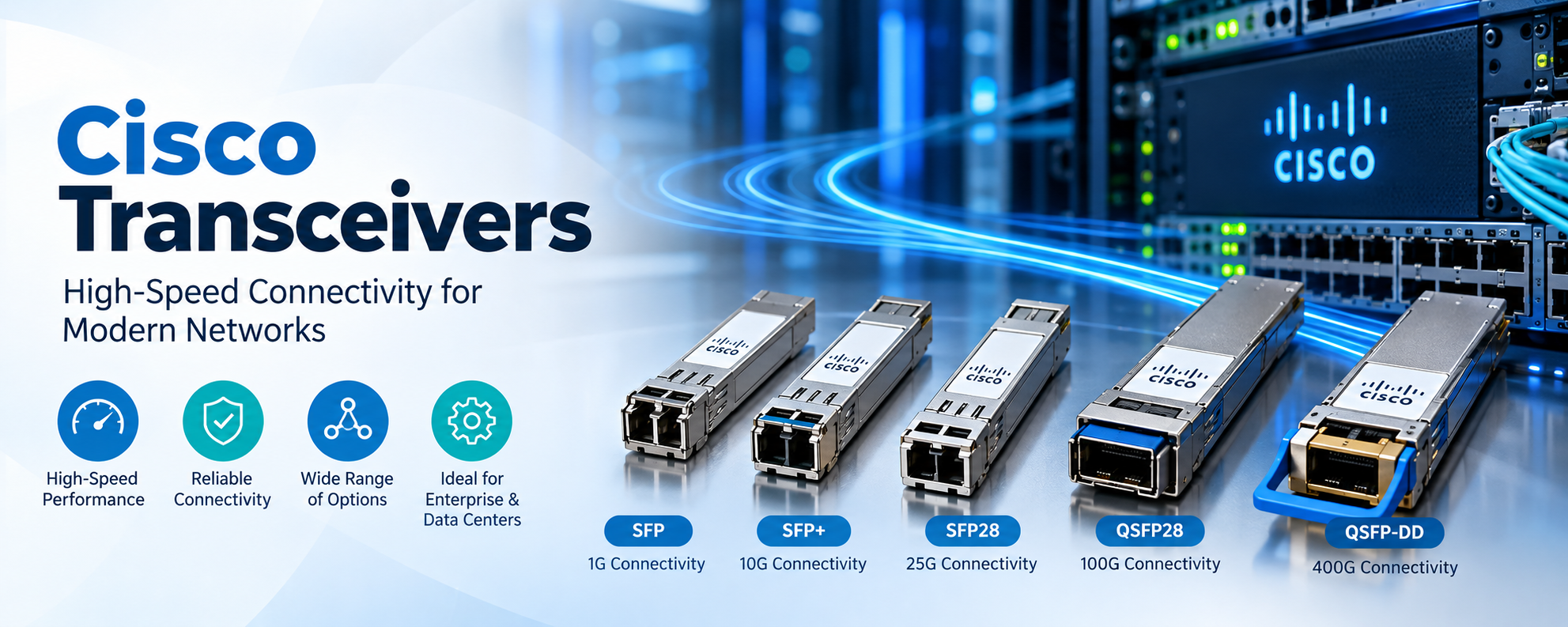
Cisco offers several transceiver families designed to support different network speeds, infrastructure requirements, and connectivity standards.
Cisco SFP Transceivers
Small Form-Factor Pluggable (SFP) transceivers are commonly used in enterprise networking environments that require Gigabit Ethernet connections.
Cisco SFP modules are available in optical and copper configurations. Popular examples include the GLC-SX-MMD for short-range multimode fiber connections and the GLC-LH-SMD for compatible longer-distance fiber connections.
These modules are frequently deployed in access-layer switches, office networks, campus environments, and connections between network equipment.
Their compact size and hot-swappable design make them convenient for maintaining and upgrading network connectivity.
Cisco SFP+ Transceivers
Cisco SFP+ transceivers are designed primarily for 10 Gigabit Ethernet connectivity.
Compared with conventional Gigabit SFP modules, SFP+ modules provide significantly greater bandwidth, making them suitable for demanding business applications.
Popular models include the SFP-10G-SR for short-range multimode fiber connections and the SFP-10G-LR for longer-distance single-mode fiber deployments.
Businesses commonly use Cisco SFP+ modules for server connections, switch uplinks, virtualization platforms, and enterprise storage networks.
Their ability to support high-speed transmission in a compact form factor makes them a practical option for organizations upgrading from Gigabit Ethernet infrastructure.
Cisco SFP28 Transceivers
Cisco SFP28 transceivers support 25 Gigabit Ethernet connectivity and are increasingly useful in modern data center environments.
These modules provide higher bandwidth per connection than traditional 10G SFP+ interfaces while maintaining a compact physical design.
SFP28 technology is commonly used for server-to-switch connections, virtualization environments, and high-performance computing infrastructure.
Organizations requiring greater bandwidth without immediately adopting 100G connectivity may find 25G networking suitable for their infrastructure.
Cisco QSFP+ Transceivers
Quad Small Form-Factor Pluggable Plus (QSFP+) transceivers are commonly associated with 40 Gigabit Ethernet networking.
They support high-bandwidth communication between compatible networking devices and are frequently deployed in enterprise core networks and data center infrastructure.
Cisco QSFP+ modules can use different optical technologies depending on the required transmission distance and fiber configuration.
Some supported QSFP+ interfaces also provide breakout functionality, allowing a 40G connection to be divided into multiple lower-speed connections when supported by the platform.
This flexibility can help organizations improve port utilization and manage infrastructure upgrades.
Cisco QSFP28 Transceivers
Cisco QSFP28 transceivers are designed primarily for 100 Gigabit Ethernet connectivity.
These modules are widely used in high-capacity data centers, enterprise backbone networks, and service provider infrastructure.
Their high bandwidth makes them suitable for handling large volumes of network traffic generated by cloud computing, virtualization, and data-intensive applications.
Depending on the model, QSFP28 transceivers support different optical standards, connection distances, and fiber configurations.
Cisco QSFP-DD Transceivers
Cisco QSFP-DD transceivers support high-density networking applications, including 400 Gigabit Ethernet connectivity.
These modules are designed for environments where large amounts of data must move between networking devices with minimal network congestion.
QSFP-DD technology is particularly valuable in modern data centers, cloud infrastructure, and high-performance computing environments.
Some compatible QSFP-DD ports also support earlier QSFP form factors, helping organizations manage gradual network upgrades. Actual backward compatibility depends on the networking platform and supported module.
Key Features and Benefits of Cisco Transceivers
High-Speed Data Transmission
One of the main advantages of Cisco Transceivers is their ability to support multiple network speeds.
From Gigabit Ethernet connections to high-capacity 400G interfaces, organizations can select suitable modules according to their bandwidth requirements.
High-speed transceivers help support data-intensive applications, large file transfers, cloud services, and communication between networking devices.
Reliable Network Connectivity
Reliable connectivity is essential for businesses that depend on continuous network availability.
Cisco Transceivers are designed to operate with supported Cisco networking platforms, helping organizations establish stable communication between compatible devices.
Choosing the appropriate module can reduce connectivity problems caused by mismatched optical standards, unsupported interfaces, or incorrect transmission distances.
Flexible Network Expansion
Modular transceiver technology allows businesses to expand or modify network connections without replacing every networking device.
For example, an organization upgrading its fiber infrastructure may be able to install different compatible transceivers to support new connection distances or bandwidth requirements.
This flexibility makes transceiver modules an important component of scalable network design.
Easy Installation and Maintenance
Many Cisco Transceivers support hot-swappable installation, allowing modules to be inserted or removed without powering down the entire networking device.
This feature simplifies maintenance and reduces disruption during supported hardware replacement procedures.
However, network administrators should follow appropriate installation practices to avoid damaging the module, connector, or networking equipment.
Common Applications of Cisco Transceivers
Enterprise Networking
Enterprise environments use Cisco Transceivers to connect networking devices across offices, buildings, and campuses.
Fiber optic connections can provide the necessary bandwidth and transmission distance for communication between access, distribution, and core networking equipment.
Organizations often use SFP and SFP+ modules for everyday connectivity, depending on their infrastructure requirements.
Data Center Infrastructure
Data centers require fast and reliable connections between servers, switches, and storage systems.
Cisco SFP28, QSFP28, and QSFP-DD modules support higher-capacity connections for applications that generate substantial network traffic.
These transceivers help data center operators design infrastructure capable of supporting virtualization, cloud computing, and high-performance workloads.
Telecommunications Networks
Telecommunications providers rely on optical transceivers to transfer information across network infrastructure.
Different optical modules support various transmission distances and network architectures, making them useful for connecting equipment throughout service provider networks.
Cloud Computing Environments
Cloud infrastructure depends on efficient communication between computing, storage, and networking resources.
High-speed Cisco Transceivers can support the bandwidth needed to transfer large volumes of information between compatible network devices.
Their modular design also helps organizations adjust network capacity as application demands increase.
How to Choose the Right Cisco Transceivers
Check Device Compatibility
Before purchasing a transceiver, verify that the specific module is supported by the networking equipment.
Not every Cisco Transceiver works with every Cisco switch or router.
Compatibility depends on the device model, port type, transceiver product identifier, and sometimes the installed software version.
Reviewing the supported optics compatibility information helps avoid installation problems and unnecessary purchases.
Determine the Required Network Speed
Businesses should evaluate their current and future bandwidth requirements before selecting transceivers.
Gigabit Ethernet modules may be sufficient for basic network connections, while demanding environments may require 10G, 25G, 40G, 100G, or higher capacities.
Selecting an appropriate network speed helps maintain performance without introducing unnecessary infrastructure costs.
Consider Transmission Distance
Different transceivers support different communication distances.
Short-range optical modules are commonly used for connections within buildings and data centers, while long-range modules are designed for supported connections across greater distances.
The selected transceiver must match the required distance and optical link budget.
Verify Fiber and Connector Requirements
Fiber type is another important consideration when choosing Cisco Transceivers.
Multimode fiber is commonly used for shorter connections, while single-mode fiber is frequently selected for longer-distance transmission.
Organizations must also verify connector types, fiber strand requirements, wavelengths, and supported optical standards.
Incorrect fiber or connector selection can prevent communication even when the transceiver fits physically into the networking device.
Common Cisco Transceiver Problems and Troubleshooting
Although Cisco Transceivers are designed for reliable operation, network administrators may occasionally experience connectivity issues.
A common problem occurs when a transceiver is not recognized by the networking device. This can happen because the module is unsupported, incorrectly installed, or incompatible with the device software.
Another issue involves optical signal loss. Dirty fiber connectors, damaged cables, incorrect fiber types, and excessive transmission distances can affect signal quality.
Speed mismatches and incorrect interface configurations may also prevent network links from becoming operational.
To troubleshoot these problems, administrators should inspect the physical connections, confirm transceiver compatibility, review interface status, and examine available diagnostic information.
Some Cisco optical modules support Digital Optical Monitoring, which provides operational measurements such as temperature, voltage, and optical transmit or receive power.
These measurements can help identify potential hardware or signal problems before they cause significant network disruption.
Are Cisco Transceivers Worth the Investment?
Cisco Transceivers can be a valuable investment for organizations building or upgrading their networking infrastructure.
Their modular design, range of supported transmission speeds, and availability across different optical technologies make them suitable for many enterprise environments.
Choosing supported Cisco modules also provides a defined compatibility path for organizations that prioritize predictable operation and vendor-supported infrastructure.
However, businesses should evaluate their networking requirements carefully rather than selecting modules based only on the highest available speed.
An appropriately selected transceiver can deliver reliable connectivity while supporting long-term infrastructure planning.
Future of Cisco Transceivers in Modern Networking
Networking requirements continue to evolve as businesses adopt cloud applications, artificial intelligence, automation, and increasingly data-intensive technologies.
These changes are creating demand for higher-capacity connections and more efficient data center infrastructure.
High-speed optical technologies, including 400G and emerging 800G deployments, are helping network operators increase bandwidth density and improve connectivity between computing resources.
At the same time, lower-speed transceiver technologies remain important for access networks, enterprise environments, and organizations with moderate bandwidth requirements.
The future of Cisco Transceivers will involve supporting a wider range of connectivity needs while helping businesses balance network capacity, operational efficiency, and infrastructure costs.
Conclusion
Cisco Transceivers are essential components of modern networking infrastructure, enabling reliable communication between switches, routers, servers, and other compatible devices.
From SFP and SFP+ modules to advanced QSFP28 and QSFP-DD technologies, Cisco offers solutions for different bandwidth requirements, transmission distances, and networking environments.
Understanding the differences between these modules helps organizations select appropriate components and avoid compatibility issues.
By considering device support, network speed, fiber requirements, and transmission distance, businesses can build efficient, scalable networks that support both current operations and future growth.
Frequently Asked Questions About Cisco Transceivers
What are Cisco Transceivers used for?
Cisco Transceivers are used to establish network connections between compatible switches, routers, servers, and other networking equipment. They enable data transmission through fiber optic or supported copper connections and are available for different network speeds and distances.
What is the difference between Cisco SFP and SFP+ transceivers?
The main difference is their typical supported data rate. Cisco SFP modules are commonly used for Gigabit Ethernet connections, while SFP+ modules are primarily designed for 10 Gigabit Ethernet. Compatibility and supported speeds depend on the module and networking device.
Can Cisco Transceivers work with non-Cisco switches?
Some Cisco Transceivers may operate with third-party networking equipment when the relevant standards and device compatibility requirements are met. However, interoperability is not guaranteed, and organizations should verify support before installation.
How long do Cisco Transceivers last?
Cisco Transceivers can operate for many years under appropriate environmental and operating conditions. Their actual lifespan depends on factors such as temperature, workload, installation conditions, component quality, and maintenance.
What is the difference between single-mode and multimode Cisco Transceivers?
Single-mode optical transceivers are commonly used for longer-distance fiber connections, while multimode optical transceivers are typically used for shorter-distance applications. The appropriate choice depends on the optical standard, fiber infrastructure, and required transmission distance.
Are Cisco Transceivers hot-swappable?
Many Cisco Transceivers support hot-swappable installation, meaning they can be inserted or removed while the networking device remains powered on. However, removing an active transceiver will interrupt the connection it serves.
How do I know whether a Cisco Transceiver is compatible with my switch?
You should verify the transceiver's exact product identifier against the supported optics information for your Cisco switch model and software version. It is also important to confirm the port type, supported speed, and optical interface specifications.
Can Cisco Transceivers improve network performance?
Cisco Transceivers can help improve network capacity when they enable supported higher-speed connections or replace unsuitable modules. However, overall network performance also depends on the switches, routers, cabling, configurations, and connected devices.
What causes a Cisco Transceiver to stop working?
Common causes include hardware failure, overheating, dirty fiber connectors, damaged cables, incompatible modules, and incorrect interface settings. Checking the device logs and available optical diagnostics can help identify the issue.
Which Cisco Transceiver is best for enterprise networking?
The best Cisco Transceiver depends on the organization's infrastructure requirements. SFP and SFP+ modules are common choices for many enterprise networks, while SFP28, QSFP28, and QSFP-DD modules are useful for higher-bandwidth environments. Device compatibility, fiber type, and transmission distance should guide the final selection.

 English
 Arabic
 French
 Spanish
 Portuguese
 Deutsch
 Turkish
 Dutch
Dutch
 Italiano
 Russian
 Romaian
 Portuguese (Brazil)
 ไทย
ไทย