


Why Human-Edited AI Content Beats Pure AI Content
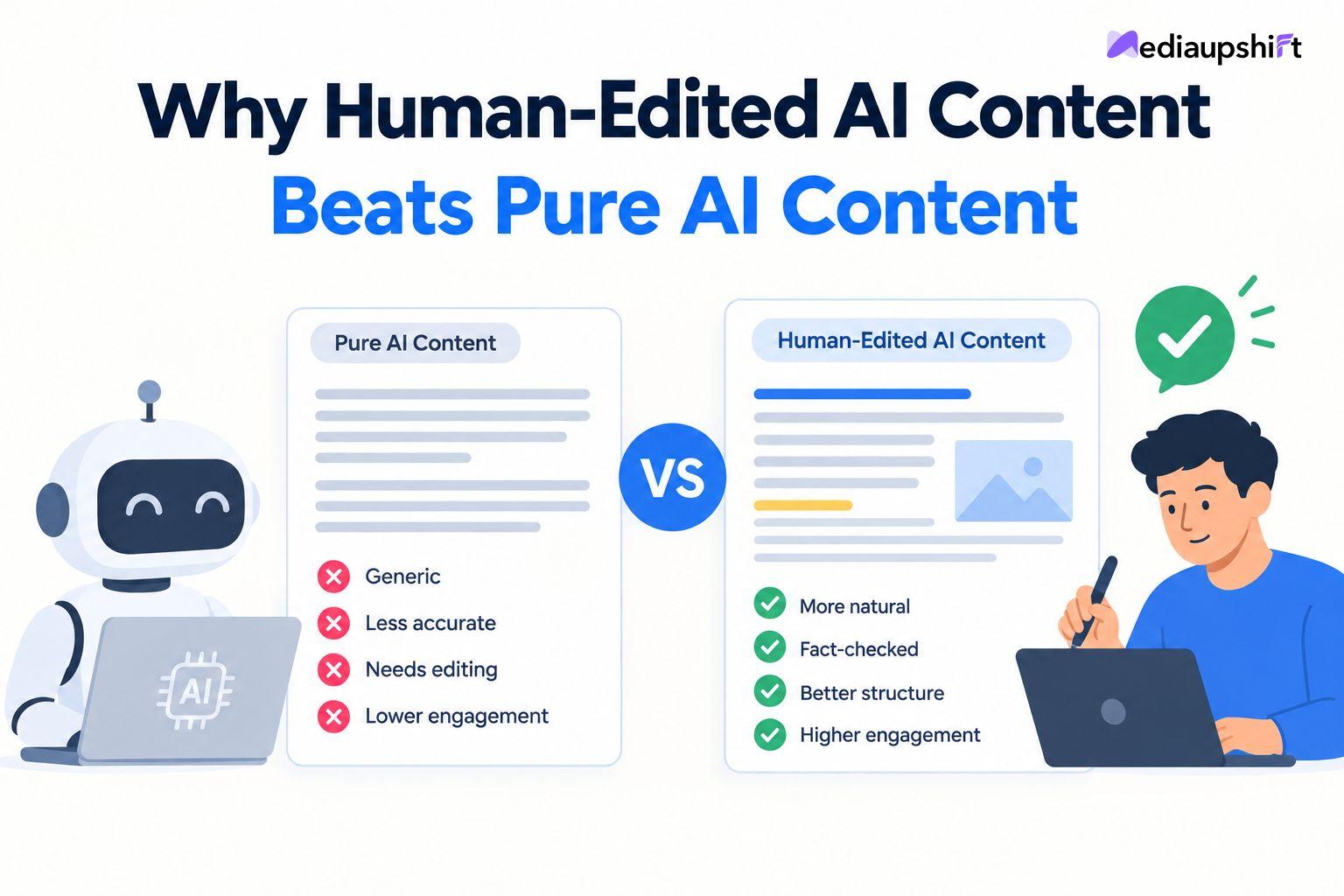
You paste a prompt into an AI tool, and thirty seconds later you have a 1,500-word blog post. It's tidy, grammatically perfect and completely forgettable. It could have been written for any business in any city.
That's the trap of pure AI content. It's fast and cheap, but it sounds like everyone else, and it can quietly include mistakes. Meanwhile, businesses that pair AI with a skilled human editor are producing content that ranks, builds trust and gets cited.
A smart SEO agency in Delhi uses AI as an assistant, not a replacement. In this guide, you'll learn what the data says, where AI falls short, how human editing improves content, and how to spot an agency that does it properly.
What Does Google Say About AI Content?
Google's position is straightforward: the method of creation isn't the issue, quality is. Using AI to help produce helpful content isn't against its guidelines. What violates its spam policies is mass-producing content mainly to manipulate rankings, often called scaled content abuse, however it's made.
In other words, AI content isn't banned. Bad content is the problem.
What the Data Shows
An Ahrefs analysis of 600,000 pages (the top 20 results for 100,000 keywords) found:
- 86.5% of top-ranking pages contained some AI-generated content
- 81.9% were a blend of AI and human input
- 4.6% were classified as fully AI-generated
- The correlation between AI use and ranking position was near zero (0.011)
- Pages ranking #1 tended to have slightly less AI content than lower-ranking ones, and fully AI pages appeared in the top 20 but rarely at #1
Two honest takeaways. First, using AI doesn't automatically hurt rankings. Second, AI-assisted content dominates the results, but pure AI rarely wins the top spot. Note that Ahrefs used an AI detector, which isn't perfect, and the study shows correlation, not proof that editing causes better rankings.
Where AI Is Great and Where It Falls Short
| Task | AI strength | Human strength |
|---|---|---|
| Brainstorming topics and outlines | Fast, wide-ranging | Choosing what matters to your audience |
| First drafts | Quick and structured | Voice, insight, originality |
| Summarising research | Efficient | Checking accuracy and sources |
| Grammar and clarity | Excellent | Context and nuance |
| Facts and statistics | Can be wrong or invented | Verifying against real sources |
| Real experience and opinions | Lacks first-hand experience | Case notes, photos, lessons learned |
| Local and cultural context | Often generic | Genuine knowledge of Delhi, NCR and your customers |
6 Reasons Human-Edited AI Content Wins
1. Accuracy and trust
AI tools can state wrong facts confidently, invent statistics or cite sources that don't exist. A human editor checks every claim, date and figure against original sources. One wrong number can undermine your credibility, especially in health, finance and legal topics.
2. Real experience and expertise
Google's quality guidelines emphasise experience, expertise, authoritativeness and trust (E-E-A-T). AI hasn't treated a patient, run a campaign or served a customer. Your team has. Adding real examples, photos, screenshots and lessons is what makes content genuinely helpful.
3. Originality
Ask five AI tools the same question and you'll get five similar answers. If your content says what everyone else says, there's little reason for anyone, or any AI search tool, to choose yours. Human editors add original data, opinions and angles.
4. Local and cultural fit
Delhi audiences search in Hindi, English and Hinglish, and they care about local details like neighbourhoods, metro stations, seasons and festivals. AI can miss these nuances. A human who knows the market catches them.
5. Brand voice
Readers can tell when something feels flat or robotic. A human editor makes content sound like your brand, warm, expert or bold, so people remember you.
6. Better odds of being cited by AI search
A Princeton-led research team (with Georgia Tech, the Allen Institute for AI and IIT Delhi) found that adding statistics, credible quotes and cited sources raised content visibility in AI-generated answers by up to 40%. Those additions are exactly what a human editor brings: verified data, real quotes and sources. Results vary, and nothing is guaranteed.
Before and After: A Quick Example
(Illustrative example.) Here's how a human edit changes a paragraph for a Delhi dental clinic.
Pure AI draft:
"Teeth whitening is a popular cosmetic treatment that can brighten your smile. There are many options available, and results vary depending on the individual."
Human-edited version:
"Most patients at our Saket clinic see a visible difference after one in-clinic session, usually about an hour. Results depend on your starting shade and habits like tea or coffee, and some people feel temporary sensitivity. Here's what we ask every patient before we start, and when we recommend waiting."
The second version has real details, honest limits and a clear next step. It sounds like a person who does this every day.
How an SEO Agency in Delhi Edits AI Content
A good process looks something like this:
- Research first. Identify what your customers actually ask, and what competitors miss.
- Use AI for structure and drafts. Outlines, first versions and ideas.
- Add expertise. A subject expert or experienced writer supplies examples, opinions and local detail.
- Fact-check everything. Verify numbers, dates, claims and quotes against original sources.
- Edit for voice and clarity. Short paragraphs, plain language, your brand tone.
- Add trust signals. Named author, credentials, reviews and clear business details.
- Check technicals. Titles, headings, internal links and schema where it fits.
- Update regularly. Refresh stats and examples over time.
A Simple Editor's Checklist
Before publishing any AI-assisted piece, ask:
- Is every statistic linked to a real, credible source?
- Does it include something only we could say, such as an example, data or opinion?
- Does it answer the question directly in the first few lines?
- Does it sound like us?
- Is it right for Delhi and our actual customers?
- Would I be comfortable putting my name on it?
If the answer to any of these is no, the draft isn't finished.
Red Flags When Hiring an Agency
- "100 articles for a tiny budget." Volume without editing usually means low quality.
- No named authors or experts.
- No fact-checking or source links.
- Every post has the same structure and phrases.
- Promises of guaranteed rankings or AI citations.
- Reluctance to explain how AI is used.
How to Choose Professional SEO Services in Delhi
When comparing professional SEO services Delhi offers, or any SEO company in Delhi, ask:
- Where do you use AI, and where do humans review?
- Who edits and fact-checks? Ask for names or roles.
- Can I see examples of your edited content and the results?
- How do you add original insight to each piece?
- How do you measure success? Leads and enquiries, not just word counts.
If you're exploring newer options, providers offering AI SEO services India wide, or a GEO agency India brands consult, should be able to explain how human editing improves both rankings and citation-worthiness.
FAQs
Is AI-generated content bad for SEO?
Not automatically. Google says it focuses on quality, and studies show most top-ranking pages contain some AI. But thin, unedited, mass-produced content can cause problems.
Does Google penalise AI content?
Google's spam policies target content made mainly to manipulate rankings, whether written by AI or people. Helpful, accurate, original content isn't penalised for using AI tools.
Should I disclose that I use AI?
Disclosure norms vary. What matters most is that the content is accurate and genuinely helpful. If you have industry or platform rules about disclosure, follow them.
Can small businesses afford human editing?
Yes. Start by editing your most important pages, such as service pages and top blog posts, and add real examples and facts. Even light editing makes a visible difference.
Conclusion
AI makes content faster to produce, but speed isn't the goal. Trust, usefulness and originality are. Human-edited AI content brings accuracy, real experience, local knowledge and voice, and that's what readers, search engines and AI tools reward.
A thoughtful SEO agency in Delhi will use AI where it helps and put people where it matters. To begin, take your three most important pages, run them through the editor's checklist and add one real example to each. If you'd like help, a short content review with a specialist team can show where to focus first.
About the author: Alia Roy is a content writer at MediaUpshift, a digital marketing website covering SEO, social media, content and paid ads. Explore more guides at MediaUpshift.

 English
 Arabic
 French
 Spanish
 Deutsch
 Turkish
 Dutch
Dutch
 Italiano
 Russian
 Romaian
 Portuguese (Brazil)
 Greek
Greek
 ไทย
ไทย