


CBSE 2027 Sample Papers: A Complete Guide for Students
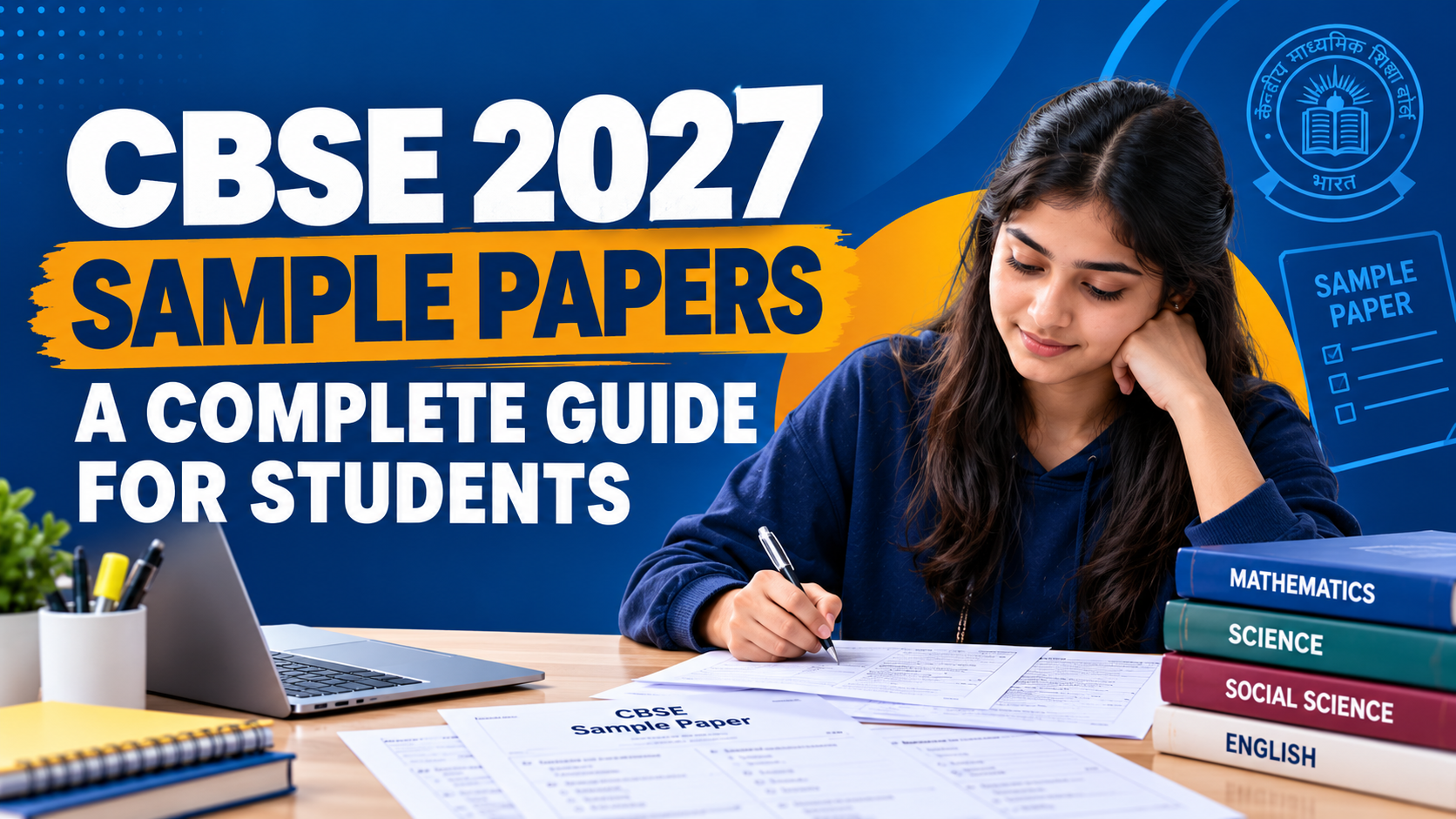
Every board exam season, one question keeps coming up in classrooms and study groups: "What will the paper actually look like?" Sample question papers (SQPs) are the closest thing to an honest answer. They show how marks are divided, what kinds of questions to expect, and how examiners want answers to be presented.
For students in Classes 10 and 12, the 2026-27 session is no different. CBSE has released the Sample Question Papers and marking schemes for the Class 10 and 12 Board Exams 2027 on its official academic website, cbseacademic.nic.in. Choosing where to prepare matters just as much as choosing what to prepare, and many families searching for the Best CBSE School in Sikar look for one that builds a habit of regular, exam-style practice alongside classroom teaching. This guide walks through how to get the most out of the new papers.
What Exactly Are CBSE Sample Papers?
A sample question paper is a model paper prepared by the board to demonstrate the design of the upcoming examination. It is not a prediction of the actual questions. Think of it as an architect's blueprint: it shows the structure of the building, not the furniture that will fill it.
The papers give students and teachers a broad understanding of the paper design, question types, syllabus coverage, and assessment approach. Each one comes with a marking scheme, which shows how the board expects answers to be evaluated. Many students overlook this second document, and it is often where the biggest gains are.
What Has Been Released for 2027?
For Class 10, sample papers and marking schemes are available for subjects including Science, Social Science, Mathematics (Basic and Standard), English and Hindi. Class 12 papers cover subjects such as Accountancy, Biology, Business Studies, Chemistry, Computer Science, Economics and English. Most SQPs are offered in both Hindi and English, while language papers appear in their respective languages.
One reassuring point comes from early coverage of the release. Students are advised to use the new SQPs to become familiar with the existing examination framework rather than expecting a completely revised pattern. Since circulars can change, check the CBSE website for updates before you finalise your strategy.
How to Download the Papers
The process is simple and free:
-
Open the official CBSE Academic website (cbseacademic.nic.in).
-
Go to the section for Sample Question Papers and Marking Scheme for the 2026-27 session.
-
Select Class 10 or Class 12.
-
Pick your subject and download both the question paper and its marking scheme.
-
Save the files in a labelled folder so you can find them quickly during revision.
Stick to the official site. Unofficial portals sometimes host altered or outdated files, and a wrong paper is worse than no paper.
Why Sample Papers Deserve a Place in Your Routine
Reading a chapter and answering questions from it are two different skills. Sample papers train the second one. Here is what regular practice gives you:
-
Pattern familiarity: You learn how many marks each section carries and where the long-answer questions sit.
-
Time management: Finishing a chapter is easy. Finishing a three-hour paper without leaving questions blank is harder.
-
Gap detection: Every wrong answer points to a weak topic that needs revisiting.
-
Lower anxiety: Facing a paper you have seen the shape of feels far less threatening.
-
Answer-writing discipline: The marking scheme shows the keywords, steps, and diagrams that earn marks.
A Quick Look at Question Formats
Recent CBSE papers have leaned toward application-based thinking rather than pure recall. Questions may include multiple-choice items, assertion-reason statements, case-based passages and source-based questions, alongside traditional short and long answers. The table below shows a general snapshot of how these formats are typically used. Exact weightage differs by subject, so treat it as an orientation, not a rule.
|
Question Format |
What It Tests |
How to Prepare |
|
Multiple-choice questions |
Concept clarity and speed |
Practise elimination; revise NCERT definitions and formulas |
|
Assertion-reason |
Understanding of cause and logic |
Judge each statement separately before linking them |
|
Case-based / source-based |
Reading, interpretation, application |
Read the passage twice and underline key data |
|
Short answer |
Precise, to-the-point explanation |
Write in 2-3 crisp lines using subject keywords |
|
Long answer |
Depth, structure, reasoning |
Use headings, steps, labelled diagrams, and a clear conclusion |
A Step-by-Step Method for Solving a Sample Paper
Simply finishing papers does not raise scores. What you do around each attempt matters more.
1. Complete the syllabus portion first. Attempt a full paper only after you have covered most of the relevant chapters. Otherwise, the result mostly reflects what you have not studied yet.
2. Recreate exam conditions. Sit at a desk, set a timer for the actual duration, keep your phone away, and avoid opening the book. Your brain remembers what it practises, including pressure.
3. Spend the first ten minutes reading. Scan the entire paper, mark the questions you are confident about, and plan your time per section.
4. Evaluate honestly. Use the official marking scheme, not your own generosity. Deduct marks where steps or keywords are missing.
5. Maintain an error log. Keep a notebook with three columns: the mistake, the reason (concept gap, careless slip, time shortage), and the fix. Reread it every week.
6. Retry the weak areas. A few days later, solve similar questions again. If the same error appears twice, the concept needs proper re-study.
A Simple Practice Plan
The schedule below is a flexible suggestion. Adjust it to your subjects, school calendar, and personal pace.
|
Phase |
Focus |
Suggested Practice |
|
Now to November |
Syllabus completion |
One chapter-wise section test per week |
|
December |
Mixed practice |
One full sample paper every week in your toughest subject |
|
January |
Exam simulation |
Two full papers weekly, strictly timed |
|
February |
Revision and polish |
Reattempt error-log questions; short daily quizzes |
|
Final two weeks |
Confidence building |
Light revision, one paper per alternate day, adequate sleep |
Common Mistakes Students Make
-
Treating the sample paper as a guessing tool. Trying to predict exact questions wastes energy. Use it to understand the style, not to gamble.
-
Skipping the marking scheme. You may be right in substance yet lose marks because you omitted a step or a key term.
-
Practising only your favourite subject. Strong subjects feel good, but weak ones are where marks are recovered.
-
Solving too many papers, too fast. Ten rushed papers teach less than three carefully analysed ones.
-
Ignoring presentation. Neat diagrams, underlined keywords, and numbered points make an answer easier to mark.
Sample Papers Are One Tool, Not the Whole Toolbox
Sample papers work best alongside NCERT textbooks, which remain the foundation of CBSE questioning. Add exemplar problems for Mathematics and Science, previous years' question papers for trend awareness, and school-level tests for regular feedback. Teachers and parents can help by reviewing answers together and pointing out patterns a student might not notice alone.
Wellbeing counts too. A student who sleeps well, eats properly, and takes short breaks will retain more than one who studies through the night. Consistency beats intensity in board preparation.
Final Thoughts
The CBSE 2027 sample papers are a free, official, and reliable window into the examination. Download them from the board's website, attempt them under realistic conditions, study the marking schemes closely, and learn from every mistake. Start early, stay steady, and let each practice paper move you a little closer to your target score.
FAQs
1. Where can I download the official CBSE 2027 sample papers?
Visit cbseacademic.nic.Open the Sample Question Papers section for the 2026-27 session, choose Class 10 or 12, and download the paper with its marking scheme, all free of cost.
2. Has the CBSE exam pattern changed for 2027?
Early reports suggest the papers follow the existing framework, so expect familiar question types and mark distribution rather than an overhaul. Always confirm details through official CBSE circulars and notices.
3. How many sample papers should I solve for each subject?
Start with the official paper, then add previous years' papers and school mocks. Two to three carefully analysed full papers per subject usually work better than rushing through many.
4. Should I attempt sample papers under timed conditions?
Yes. Sit quietly, set a timer equal to the real exam duration, and avoid notes. Timed practice builds pacing, stamina, and confidence, which all matter on exam day.
5. Are sample papers enough to score well in boards?
No. Combine them with NCERT textbooks, exemplar problems, and previous year questions. Sample papers show the format, but complete syllabus coverage prepares you for unfamiliar questions.
6. When should I begin solving full-length sample papers?
Begin once you have covered most chapters, ideally by December. Increase frequency in January and February, and keep the final weeks for revision, error-log review, and confidence-building mocks.

 English
 Arabic
 Spanish
 Portuguese
 Deutsch
 Turkish
 Dutch
Dutch
 Italiano
 Russian
 Romaian
 Portuguese (Brazil)
 Greek
Greek
 ไทย
ไทย