


HDPE T-Rib Liner Sheets for Waterproofing and Concrete Protection
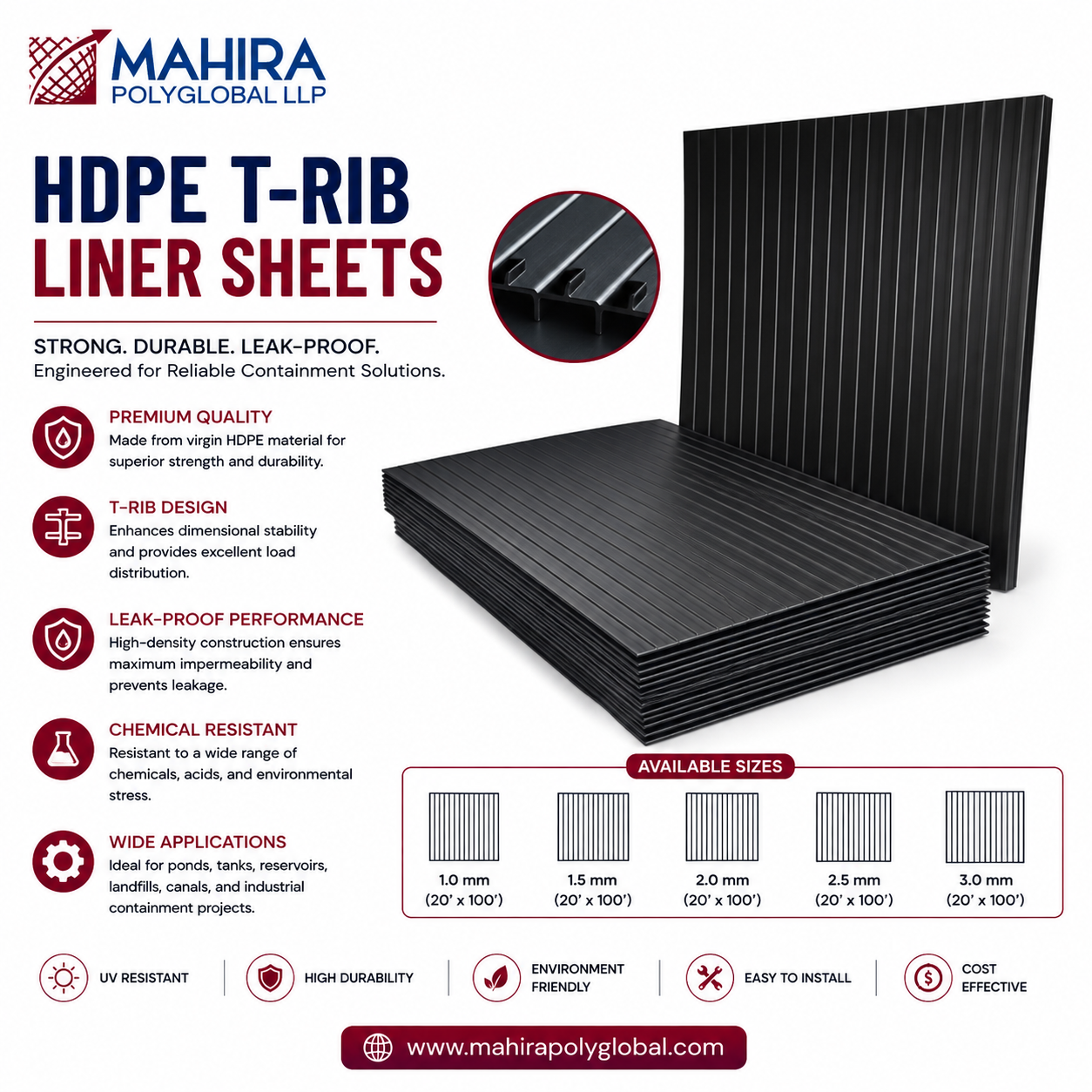
High density polyethylene T-Rib liner sheets, which are also known as high-density polyethylene membranes, provide an impermeable barrier to protect concrete structures from water infiltration and acid attack, abrasion as well as corrosion. This means one side of the mesh is T-shaped and sits inside freshly placed concrete, creating a mechanical lock between liner and structure. This is the smooth face that stays in contact with water, wastewater, chemicals or soil to form a protective barrier. They are often fitted in tunnels, RCC pipes, sewage treatment plants, etc., wet wells (WW), canals, manholes (MW), tanks (WT), basements and industrial containment structures. A T-Rib liner bonds itself to the cast concrete as opposed to laying a loose sheet against the concrete after curing. That is its main advantage. But the liner is certainly no panacea for shoddy concrete work. Welding defects, part not properly placed in the formwork, careless positioning of pouring concrete can reduce performance. Good material needs good installation.
How the T-Rib Lock Works
T-shaped ribs are the main attraction of Hdpe t Rib liner sheets. The ribs become embedded within the flowing concrete when it is cast. Once the concrete has cured, the ribs produce a physical or mechanical anchor making the membrane harder to separate from the surface of the concrete. This anchoring system minimizes the odds of water moving between the liner and concrete if seams, penetrations and terminations are properly sealed. You can prefabricate the liner into panels or blankets, place them on formwork and cast to position. The smooth HDPE surface contacts the liquid (or soil or chemical environment) and the ribbed face locks into the concrete. Well, that sounds simple enough, but there are caveats. It depends on rib depth, sheet thickness, welding tech, concrete compaction and seams layout. Even a mechanically anchored liner can leak if the welds on the joints are not proper.
Waterproofing and Water Management
While there are many applications for structural and non-structural drainage system liners, a T-Rib liner is generally the go to when concrete needs to either keep water in or out. They can be used to line water tanks, reservoirs, canals, drainage channels, sewage pipes, basements, pump stations, culverts and wet wells and wastewater treatment structures. The HDPE barrier mitigates the permeability of concrete and therefore protect the structure from moisture damage. It may also be applied to underground structures to mitigate groundwater intrusion and long-term moisture. T-Rib liners are specialized technical details and these patterns form a waterproofing barrier and protective system in subterranean and hydraulic infrastructures. But, waterproofing is never just a sheet. Incompatible detailing will be required for construction-joints, pipe-entries, expansion joints/corners and damaged areas. The water takes the path of least resistance it is not the largest surface area. No liner in the world will save an unsealed penetration. Engineers should plan complete waterproofing that includes sheets, welds, detailing, testing and inspection.
Concrete Corrosion Protection
Sewage, industrial effluent, chemicals and chemical environments, acidic environments, salts compounds in construction calcifications due to biological activity of organisms under some conditions the gases emitted have corrosive properties that damage the concrete by simply being exposed to such substances. HDPE T-Rib liners provide a durable physical barrier between the concrete substrate and these aggressive environments. Such an extension of the useful life of concrete structures can lead to reduced repair demands. Such systems are typically provided for sewage treatment plants, chemical tanks, wastewater channels, concrete pipelines and industrial containment areas by Hdpe t rib liner manufacturer companies. In sewage, the liner protects concrete from wastewater, microbial activity and corrosive gases that would otherwise compromise the surface. Chemical resistance should be tested against the precise chemical agent, concentration, temperature and time period of exposure. HDPE is resistant to many substances but not all substances under all conditions. As such, a shop should provide an industrial-resin flooring with a generic “chemical-resistant” claim to make. Before choosing the lining system make sure all compatibility checks are completed.
Major Application Areas
Our HDPE T-Rib liner sheets are utilized in numerous civil, municipal, environmental and industrial applications. They are employed in clarifiers, reaction vessels, collection basins, sumps, grit chambers, wet wells and sewage channels found within wastewater treatment facilities. Concrete projects in municipal work, like drainage pipes and culverts, and construction tasks for canals, underground chambers and water-control structures all make use of them. They are used in tunnels, metro structures, basements, lift pits, pipe galleries and underground utility corridors to resist groundwater and protect concrete. Specialized T-Rib liners can also be installed in chemical storage tanks, effluent collection tanks, secondary containment systems as well as in reactors and concrete structures that are exposed to acids or alkalis. Uhde India provides HDPE T-Rib Lining on RCC Pipes, Concrete Tunnels, Wet Walls of Waste Water Treatment Plant and canals Singhal Industries , but design within a narrow range. For instance, a chemical containment tank might be required to have different thickness and welding details compared for a tunnel lining.
Material Features and Selection
HDPE T-Rib liners are low moisture absorption film, with abrasion and chemical resistance, long service life, impact resistance and flexibility. These can be supplied in diverse thicknesses, widths, rib patterns and colors in roll or sheet formats. Regardless of the purpose, the thickness of a sheet should be selected based on these factors: water pressure, exposure to abrasion, chemical environment, concrete structure and installation method. Thicker liner will better protect higher wear surface, abrasive or high-risk areas but may create dimensional variances affecting the handling and forming of finished part; requiring additional welding effort. The ribs have to be robust enough for good anchoring in the concrete, with the smooth face staying contiguous and defect-free. Buyers are encouraged to ask for specifications on density, thickness tolerance, tensile strength, elongation, seam-weld capability as well as chemical resistance and UV stability properties along with rib geometry. Do not choose a liner based on thickness alone. An example would be a 1 mm sheet with bad welding or incorrect anchoring of the ribs, then it works worse than a properly constructed and installed thinner system.
Choosing Singhal Industries Pvt Ltd
Things to consider when selecting an HDPE T-Rib liner supplier include review of manufacturing capability, raw material quality, sheet thickness range, rib profile and fabricating support along with welding guidance and help on quality tests for the particular project. Singhal industries Pvt Ltd is also the Manufacturer, Supplier and Exporter of HDPE T-Rib liner sheets in Gujarat. The product information characterizes the material as a flexible HDPE sheet equipped with T-locking extensions intended for RCC pipes, concrete passages, wet dividers, wastewater treatment plants and canals. Another TradeIndia listing cites Singhal Industries as the acclaimed manufacturer, supplier and exporter of HDPE T-Rib liners from Gandhinagar (Gujarat). Buyers are directed to verify thickness range, MST capability, chemical compatibility, maximum size possible for fabrication, MOQ [Minimum Order Quantity], sample policy and delivery of projects directly. Request documentation and installation instructions. A good supplier will be willing to talk about seams, weld testing, corner details, penetrations and inspection procedures not just sheet prices.
Conclusion
Installation needs to be planned prior to concrete pour. Position the panels properly on the formwork, weld seams only done by trained labor and ribbed side facing concrete. The exposed face — it must stay smooth and clean (no punctures, no contamination, no damage due to construction, etc.). Welds shall be inspected and tested according to the project quality plan. Sealing penetrations joints and transitions should be performed after placement. On the other hand, routine inspection during service can help detect signs of physical damage, chemical attack, corrosion/loss of deposits or joint damage before it looks like a big failure. To sum up, HDPE T-Rib liner sheets are a trusted method of waterproofing and concrete protection in wastewater, water management, tunnels, canals, RCC pipes, tanks, basements and industrial containment works. Its physical anchoring device, resistance to chemicals, and its optical group PHDE barrier can keep concrete away from damages for a long time. However, proper material selection and professional installation are key factors when it comes to the system. Strong underliner, but the devil is in the details.
Frequently Asked Questions
Q1. What is the use of HDPE T-Rib liner sheet?
They are widely used in wastewater plants, RCC pipes, concrete tunnels, wet wells; canals; tanks and basements; drainage structures and chemical containment systems for waterproofing and concrete protection.
Q2. How do HDPE T-Rib liners attach to concrete?
The T-shaped ribs are inserted into a new concrete layer and serve as a mechanical lock that attaches the liner to the concrete structure.
Q3. Are HDPE T-Rib liners chemical resistant?
They are also resistant to moisture, many chemicals, abrasion and corrosion. However, compatibility should be confirmed for the specific chemical, concentration, temperature and duration of exposure.
Q4. What should I ask an HDPE T-Rib liner manufacturer?
Inquire on the thickness shelf, rib design, tensile strength of steel, seam weld testing results, chemical compatibility data and UV resistance as well as proper fabrication/installation guidelines including any test samples or quality documents needed to demonstrate your equipment meets a required standard specification with recipient job reference information!
Q5. Who is the largest Suppliers of HDPE T-Rib Liner Sheets?
There is not a single, objectively verifiable public ranking proving which company supplies the most globally. It is an Indian manufacturer, supplier and exporter of HDPE T-Rib liner sheets are used to protect the concrete in waterproofing projects (Mahira Polyglobal LLP) You need to compare the material, thickness range, rib profile, fabrication support, testing assistance and technical help, pricing and delivery reliability/project experience before palcing order with any supplier.

 English
 Arabic
 French
 Spanish
 Portuguese
 Deutsch
 Turkish
 Dutch
Dutch
 Italiano
 Russian
 Romaian
 Greek
Greek
 ไทย
ไทย