


DGFT Restricted Import License for Gas Import – Check Requirements & Apply Now
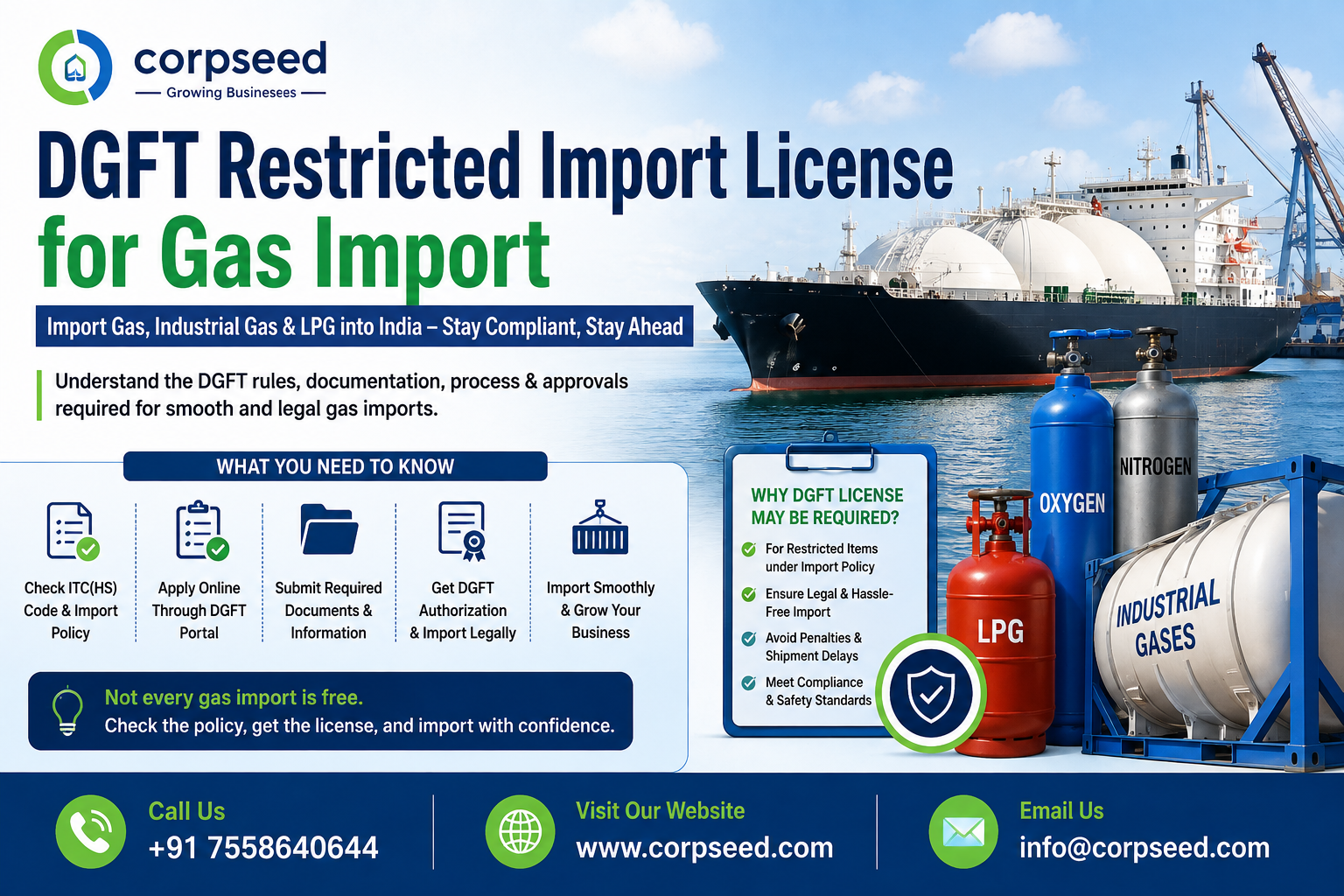
Introduction
One wrong classification can hold up your gas shipment at customs or leave you importing without the approval you actually need. If you deal in LPG, industrial or specialised gases, understanding the DGFT Restricted Import License for Gas Import is essential before placing your next order.
Importing gas into India can involve more than finding an overseas supplier and arranging shipment. A wrong ITC(HS) classification or missing DGFT approval can lead to delays, additional compliance issues, or problems during customs clearance.
For businesses importing LPG, industrial gases, specialised gases or other regulated products, knowing whether the product falls under the restricted category is an important first step. The DGFT Restricted Import License for Gas Import may be required depending on the product classification and applicable import policy.
In this guide, we explain when a DGFT licence is required, how to check the import status of your gas product, what documents you need, how to apply, and what other approvals you may need before importing into India.
What Is a DGFT Restricted Import License
A DGFT restricted import licence is an authorisation that permits an importer to bring goods into India when the applicable import policy classifies those goods as Restricted.
DGFT’s Foreign Trade Policy states that restricted goods may be imported only in accordance with an authorisation, permission or procedure prescribed through the applicable policy, notification or public notice.
Therefore, the first step is not applying for a licence. It is identifying the correct product classification and checking its current import policy.
For gas and LPG imports, this distinction matters because different gases can fall under different ITC(HS) codes and policy conditions.
Is a DGFT License Required for Every Gas Import
No. Not every gas import automatically requires a DGFT restricted import licence.
The requirement depends on the product’s ITC(HS) classification and the policy condition attached to that classification. DGFT’s import policy distinguishes between Free, Restricted, Prohibited and State Trading Enterprise (STE) categories. Restricted goods require the applicable DGFT authorisation or permission.
Before placing an import order, businesses should verify:
-
Exact product description
-
ITC(HS) code
-
Current import policy status
-
Policy conditions attached to the code
-
Quantity or value restrictions, if any
-
End-use or actual-user requirements
-
Other approvals required for the particular gas
-
Customs and safety requirements
This check can prevent a common mistake: assuming that a product is freely importable because another product with a similar commercial name has a different classification.
DGFT Restricted Import License for Gas, Industrial Gas & LPG
The word “gas” includes different products. According to the type of the business an importer may trade in LPG propane butane, oxygen nitrogen hydrogen, carbon dioxide helium refrigerant gases or any other industrial and specialty gases.
Requirements of DGFT for particular gas are dependent on whether the gas is being imported or exported.
Corp Seed’s service page is accurate in highlighting that the nature of the gas products, the ITC(HS) codes and the terms of the applicable Foreign Trade Policy play a decisive role in determining if the gas is to be classified among the restricted or otherwise goods.
That means, the first thing an importer should do is to find out the exact nature of the product they wish to import and based on that decide whether a DGFT Restricted Import License for Gas Import is needed.
LPG Imports
LPG and other petroleum gases require particular attention because their classification, policy conditions and additional regulatory requirements can affect the import process.
DGFT’s trade data identifies petroleum gas products under specific ITC-HS classifications, demonstrating why the exact product and classification matter when assessing import requirements.
An LPG importer should therefore verify the current DGFT import policy along with requirements imposed by other competent authorities before arranging shipment.
What Is the Difference Between Restricted and Prohibited Imports
This difference is relevant to every importer.
Free: The product can usually be imported without a DGFT import permit, subject to the relevant policy conditions and other regulations.
Restricted: The product could only be imported upon receiving necessary authorization, approval or license and satisfying the relevant conditions.
Prohibited: The import is generally not endorsed by the governing policy.
STE: The product may be imported through the specific State Trading Enterprises, subject to the applicable conditions.
The DGFT’s ITC(HS) import regulations utilize these categories to clarify how the goods are under formal regulation.
A restricted good is, therefore, different from a prohibited good. A company can make legal import of a restricted good after receiving the necessary approval.
Who Can Apply for a Restricted Import Authorisation
Businesses importing restricted goods generally need an active foreign trade profile and the required Importer Exporter Code (IEC).
DGFT’s restricted import FAQ states that the applicant’s user profile must be linked with an IEC and that a valid Digital Signature Certificate (DSC) must be registered in the system for the restricted-import application process.
Depending on the product and policy condition, the applicant may also need to demonstrate the intended use of the imported goods and provide technical or commercial information.
Typical applicants may include:
-
Manufacturers importing industrial gases
-
Chemical manufacturers
-
Pharmaceutical and healthcare businesses
-
Engineering and industrial companies
-
Gas distributors and traders
-
Research and technical institutions
-
Businesses importing specialised or regulated gases
-
Other eligible entities covered by the applicable policy
Eligibility should always be assessed against the specific product and current DGFT policy.
What Is DGFT Registration and Why Is It Important
DGFT registration usually refers to the process of creating and maintaining a company’s profile on the DGFT website to avail of foreign trade-related services.
IEC is essentially a prerequisite for a business involved in imports and exports. The restricted import scheme involves linking the profile of the importer to the IEC.
Nevertheless, DGFT registration or IEC does not in itself permit one to import any product.
In case the commodity is restricted, separate product-specific permission may be required by the importer.
DGFT License vs DGFT Certificate
Businesses sometimes use the term DGFT certificate broadly for DGFT-issued documents. In practice, different documents serve different purposes.
An IEC identifies an importer or exporter for foreign trade, while a restricted import authorisation gives permission for the applicable restricted goods subject to its conditions.
Therefore, obtaining an IEC or another DGFT document should not be treated as automatic approval to import restricted gas or LPG.
The actual requirement depends on the product, classification and current policy.
How to Check DGFT License Status
After submitting your application, monitor the status of the application via your DGFT account.
DGFT portal offers the restricted import system tracking, application-related and draft management features. At the same time applicants have to keep a look out for follow-up questions or requests for further information.
In general, it is advantageous to verify the DGFT license status regularly as a pending question might need to be answered before the application can be moved forward.
Have your application/ file no readily available during status checking/ communications with the authorities.
What Is a Special Import License from DGFT
The word “DGFT special import licence” is sometimes used by businesses as a generic phrase to mean permission for imports that are controlled or restricted.
However, in the case of current applications, the relevant term is actually “Authorisation for Restricted Imports,” in which the relevant item has an ITC(HS) code that is classified as Restricted and the policy mandates prior approval from the DGFT.
According to the DGFT Handbook of Procedures, all applications related to items restricted for imports can be submitted online to the DGFT Headquarters on ANF-2M.
The specific authorisation and conditions for a particular product depend on its nature and the relevant policy.
Do Gas Importers Need Other Approvals
A DGFT authorisation may not be the sole compliance requirement.
The storage, transportation and hazardous nature of gases, LPG and industrial gases can impose extra requirements about safety, environmental compliance, petroleum products hazards customs and other sector-specific areas.
The relevant authority is determined by the type of product and activity.
That’s why, import operations should first evaluate:
DGFT requirements + Product specific regulations
Just getting a DGFT authorisation shouldn’t be considered as full regulatory clearance for the whole operation.
DGFT License for Gold Import: Is It the Same Process
The DGFT license for gold imports is a separate issue and should not be confused with gas import licenses.
Gold has its own set of restrictions and regulations in foreign trade, as the rules can change through various notifications and revisions in the policy. Foreign Trade Policy mentions that import restrictions about gold and silver are valid reasons for the imposition of trade restrictions.
Hence, traders importing gold should verify the current ITC(HS) classification and policy guidelines specific to gold and not use those for industrial gas or LPG.
What Is the DGFT Restricted Items List
There is no safe way to rely on a generic, old “restricted items list” without checking the current ITC(HS) policy.
DGFT’s policy schedules identify the import status of products according to their tariff classification and applicable policy conditions. The status can change through notifications and amendments.
For an importer, the most reliable approach is:
-
Identify the correct ITC(HS) code.
-
Check the current DGFT import policy.
-
Read the policy condition attached to that code.
-
Check whether a DGFT authorisation is required.
-
Review other product-specific approvals.
This is especially important for gas and LPG products because similar commercial descriptions can cover products with different classifications.
Can You Get a PDF List of DGFT Restricted Items for Import
A restricted import application can face delays when the information does not clearly establish what is being imported and why.
Common issues include:
-
Incorrect or incomplete ITC(HS) classification
-
Vague product descriptions
-
Technical specifications that do not match the proposed goods
-
Incorrect quantity or value
-
Missing supporting documents
-
Mismatch between business records and application details
-
Failure to respond to DGFT queries
-
Ignoring additional approvals applicable to the product
-
Applying under the wrong authorisation category
For gas and industrial gas imports, technical clarity is particularly important because product names alone may not provide enough information for classification.
Why Correct Classification Matters Before Importing Gas
The biggest compliance mistake often happens before the licence application: the importer selects the wrong classification.
The ITC(HS) code affects the applicable import policy. That policy then determines whether the product is Free, Restricted, Prohibited or subject to specific conditions.
A wrong classification can therefore affect:
-
Whether authorisation is required
-
Which application should be filed
-
What documents are needed
-
Whether additional approvals apply
-
Customs clearance
-
Import costs and timelines
Taking time to verify the classification before placing the purchase order can help prevent avoidable problems later.
Final Checklist for Gas, Industrial Gas & LPG Importers
Before importing a regulated gas product into India, confirm:
-
The business has an active IEC.
-
The DGFT profile is correctly linked to the IEC.
-
The product’s ITC(HS) code has been verified.
-
The latest import policy has been checked.
-
The product is not being incorrectly treated as Free or Restricted.
-
Required DGFT authorisation has been identified.
-
Technical specifications are accurate.
-
Supporting documents are complete.
-
Additional product-specific approvals have been reviewed.
-
The DGFT application status is monitored after submission.
-
Customs documentation matches the approved import details.
Get Professional Assistance for DGFT Restricted Import Licensing
When importing gas, whether industrial or LPG, there are many factors that must be taken into consideration in terms of classification, policy compliance, and paperwork. A company should make sure that the product in question is indeed in the restricted category prior to applying for an import authorisation.
Corpseed puts importers in touch with DGFT Restricted Import License for gas import, which also covers the paperwork, application process, DGFT formalities, and follow-up.
If you would like to receive support with your import issues, please contact Corpseed.
Frequently Asked Questions
How do I get a DGFT license for restricted items?
Initially identify the Indian Trade Classification code, ITC(HS) of the item and check its restrictiveness. Then proceed to make an online application on the DGFT’s Import Management System along with the necessary documentation.
What are the import restrictions for Restricted Items in India?
Restricted items can be imported only after obtaining the necessary permission and approval as per the import prohibition policy.
What is a DGFT import license?
A DGFT import authorization gives importers the permission to import the restricted goods under the applicable foreign trade policy.
Can you provide a PDF list of DGFT restricted items for import?
DGFT publishes ITC(HS) policy material, but importers should verify the latest classification and policy condition because restrictions can change through notifications and amendments.
What is a DGFT license for gold import?
A DGFT license for gold import refers to the applicable authorisation or permission required under the current policy for regulated gold imports; requirements depend on the specific product and prevailing rules.
What is a special import license from DGFT?
It generally refers to authorisation required for controlled imports; for Restricted items, DGFT uses the restricted-import authorisation process prescribed under its current procedures.
How can I check my DGFT license status?
Applicants can monitor their application through their DGFT account and track queries or requests for additional information using the relevant application details.
Fore more info: https://www.corpseed.com/service/dgft-restricted-import-license-for-lighters-parts

 English
 Arabic
 Spanish
 Portuguese
 Deutsch
 Turkish
 Dutch
Dutch
 Italiano
 Russian
 Romaian
 Portuguese (Brazil)
 Greek
Greek
 ไทย
ไทย