


What Features Should You Expect from Real Estate Website Design in Dubai?
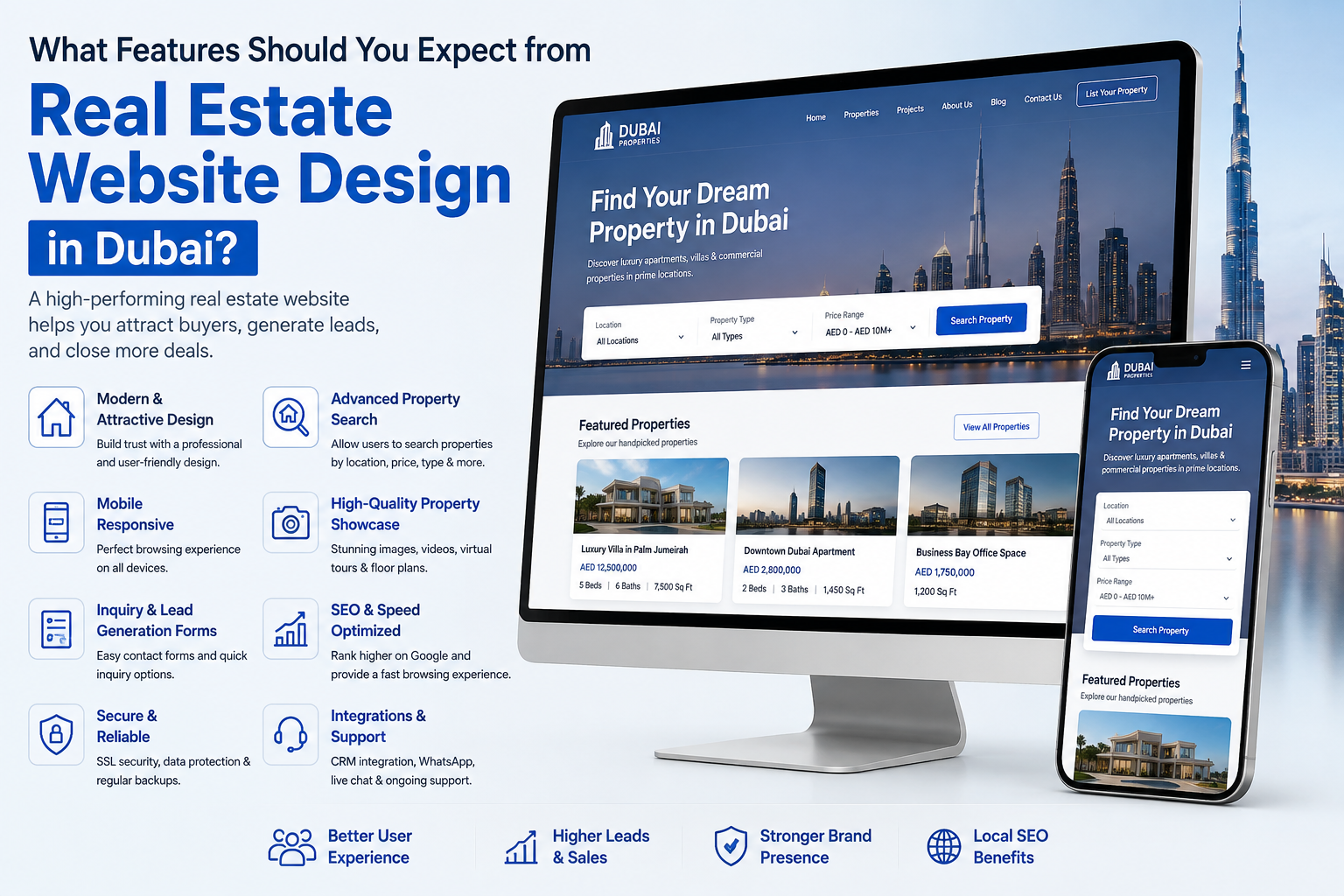
Dubai's property market is one of the most dynamic in the world, attracting investors, homebuyers, and tenants from every corner of the globe. With such a diverse and demanding audience, a real estate website design in Dubai cannot simply be a digital brochure. It needs to function as a powerful sales tool, a trust-building platform, and a seamless gateway between buyers, sellers, agents, and developers. Whether you are a real estate agency, a property developer, or an independent broker, understanding the essential features of a high-performing real estate website is critical to standing out in this competitive market.
Below, we break down the must-have features that define effective real estate website design in Dubai.
1. Advanced Property Search and Filtering
The cornerstone of any real estate website is its search functionality. Dubai's property market includes everything from luxury villas on Palm Jumeirah to affordable apartments in Dubai South, so users need the ability to narrow down listings quickly and accurately.
A well-designed search system should include filters for:
- Location or community (Downtown Dubai, Dubai Marina, JVC, Business Bay, etc.)
- Property type (apartment, villa, townhouse, penthouse, commercial)
- Price range, in both AED and other major currencies
- Number of bedrooms and bathrooms
- Property status (ready, off-plan, under construction)
- Payment plans, especially for off-plan projects
Map-based search is particularly valuable in Dubai, where buyers often care deeply about proximity to metro stations, schools, beaches, or business districts. An interactive map that displays listings by neighborhood adds significant value and reduces the time users spend hunting for the right property.
2. High-Quality Visual Content
Dubai real estate is a visually driven market. Buyers, especially international investors, often make purchasing decisions without physically visiting a property, at least in the early stages. This makes visual content non-negotiable.
Expect the following visual features on a strong real estate website:
- Professional high-resolution photography for every listing
- Virtual tours and 360-degree walkthroughs
- Drone footage for large developments or waterfront properties
- Video walkthroughs highlighting key selling points
- Interactive floor plans that allow users to visualize room layouts
Given the number of off-plan projects in Dubai, 3D renderings and architectural visualizations are also essential, since buyers are often purchasing a property that hasn't been built yet.
3. Mobile Responsiveness
A significant portion of Dubai's property searches happen on mobile devices, particularly among international buyers browsing while traveling or during off-hours. A real estate website must be fully responsive, meaning it adapts seamlessly to smartphones, tablets, and desktops without losing functionality or visual quality.
Mobile responsiveness isn't just about resizing content. It also means:
- Fast loading times on mobile networks
- Touch-friendly navigation and filters
- Click-to-call buttons for instant agent contact
- Simplified forms that are easy to complete on smaller screens
Google also prioritizes mobile-friendly websites in search rankings, so this feature directly impacts visibility as well as user experience.
4. Multilingual and Multi-Currency Support
Dubai attracts buyers from across the world, including Europe, Asia, Africa, and the wider Middle East. A real estate website targeting this audience should offer multilingual support, commonly including English, Arabic, Russian, Chinese, and French, depending on the target demographic.
Equally important is multi-currency display. International investors want to view property prices in their home currency rather than manually converting from AED. Even a simple currency toggle can significantly improve user trust and comfort, making the platform feel tailored to a global audience rather than a purely local one.
5. Lead Generation and CRM Integration
At its core, a real estate website exists to generate qualified leads. This means the design must be optimized to convert visitors into inquiries, not just showcase listings.
Key lead-generation features include:
- Clear, strategically placed call-to-action buttons ("Schedule a Viewing," "Request a Callback," "Download Brochure")
- Contact forms that are short and easy to complete
- Live chat or WhatsApp integration, since WhatsApp is widely used for business communication in the UAE
- Automatic lead capture that feeds directly into a CRM system
- Email and SMS notification triggers for new inquiries
Seamless CRM integration ensures that no lead falls through the cracks and that agents can respond quickly, which is often the deciding factor in a fast-moving market like Dubai's.
6. Off-Plan Project Showcases
Off-plan properties make up a substantial share of Dubai's real estate transactions, so a dedicated section for these projects is essential. This section typically includes:
- Developer profiles and track records
- Project timelines and expected handover dates
- Detailed payment plan breakdowns
- Master plan layouts showing amenities and unit distribution
- Comparison tools for evaluating multiple off-plan projects side by side
Buyers investing in off-plan properties are making decisions based on trust and projected value, so transparency in presenting this information is a major factor in conversion.
7. Mortgage and ROI Calculators
Financial tools add tremendous practical value for buyers and investors. A mortgage calculator helps users estimate monthly payments based on property price, down payment, interest rate, and loan tenure, giving them a realistic picture of affordability.
For investors, a Return on Investment (ROI) calculator or rental yield estimator is equally valuable. Dubai's appeal as an investment hub means many buyers want quick insight into potential rental income and appreciation before committing further. Including these calculators directly on the website reduces friction and keeps users engaged longer.
8. Verified Listings and Trust Signals
Trust is a major concern in real estate, particularly for overseas buyers unfamiliar with the local market. A well-designed Dubai real estate website should incorporate trust-building elements such as:
- RERA (Real Estate Regulatory Agency) registration details
- Verified listing badges
- Agent profiles with credentials, experience, and client reviews
- Testimonials and case studies from past clients
- Transparent company information, including office locations and licensing
These signals reassure users that they are dealing with a legitimate, regulated entity, which is especially important given the volume of international transactions in Dubai's property sector.
9. Blog and Market Insights Section
An informative content section serves two purposes: it improves SEO performance and positions the agency or developer as a knowledgeable authority. A blog covering topics like market trends, area guides, investment tips, and legal processes for foreign buyers helps attract organic traffic and builds long-term credibility.
Regularly updated content also signals to search engines that the website is active and relevant, which can improve rankings for competitive real estate keywords in Dubai.
10. Fast Performance and Strong SEO Foundation
Finally, none of these features matter if the website is slow or difficult for search engines to index. Real estate websites tend to be image and video-heavy, so performance optimization is critical. This includes:
- Compressed images and lazy loading
- Clean, SEO-friendly URL structures
- Optimized meta titles and descriptions for listings and location pages
- Schema markup for property listings, which helps listings appear with rich snippets in search results
- Secure hosting with SSL certification
A technically sound foundation ensures the website ranks well, loads quickly, and provides a smooth experience across all devices, which ultimately supports every other feature built on top of it.
Final Thoughts
Real estate website design in Dubai needs to balance visual appeal, functionality, and trust in a market defined by high stakes and international reach. From advanced search filters and immersive media to multilingual support and robust lead-generation tools, each feature plays a specific role in guiding visitors toward a decision. Agencies and developers that invest in a comprehensive, user-focused website are far better positioned to capture leads, build credibility, and convert Dubai's diverse buyer pool into long-term clients.

 English
 Arabic
 French
 Spanish
 Portuguese
 Deutsch
 Turkish
 Dutch
Dutch
 Italiano
 Russian
 Romaian
 Portuguese (Brazil)
 ไทย
ไทย