


What Does AWS Cloud Billing Software Do for Businesses?
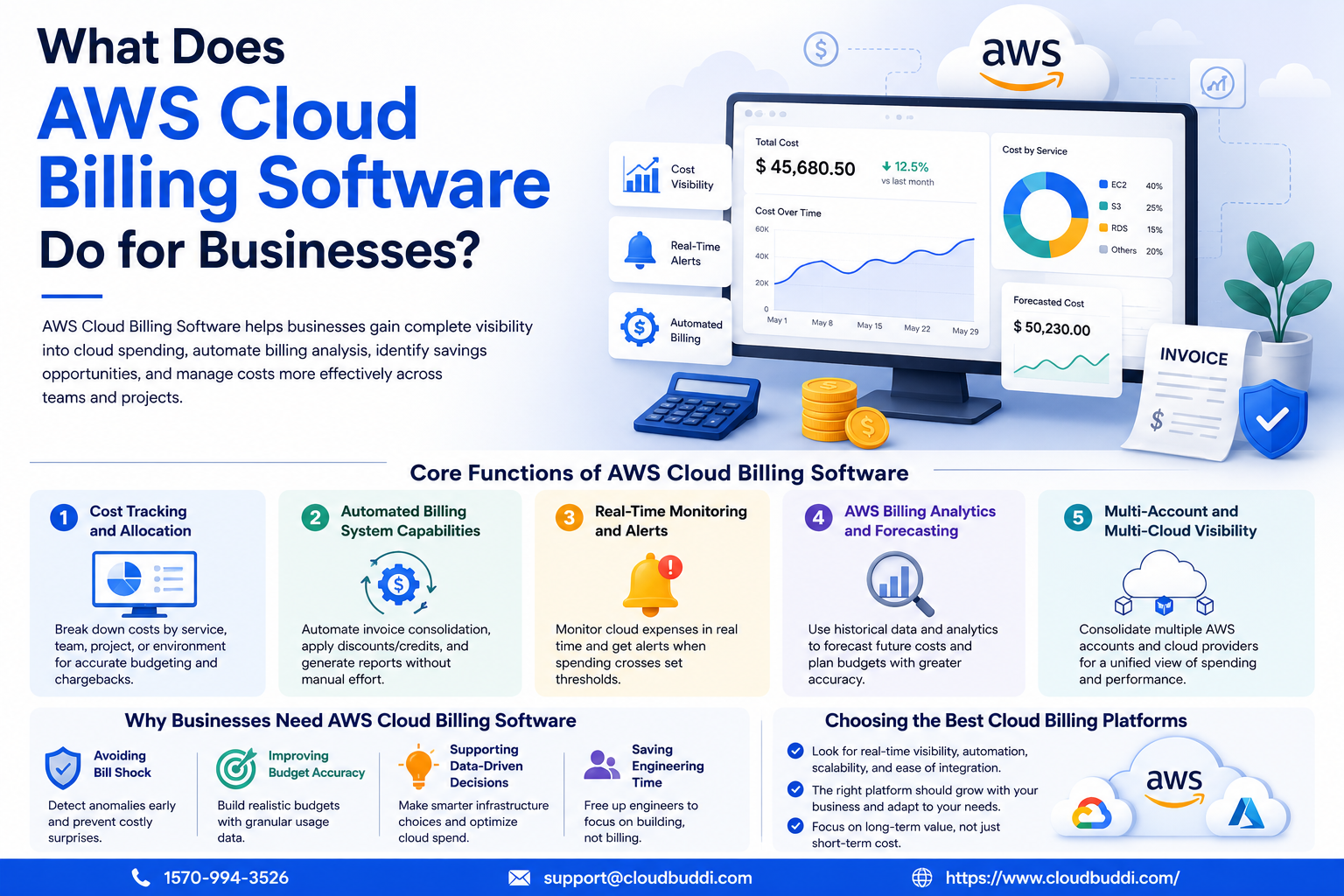
Cloud spending has become one of the trickiest line items for modern businesses to control. Teams spin up resources across regions, services, and accounts, and by the time the invoice arrives, nobody can quite explain where the money went. This is exactly the problem that AWS Cloud Billing Software was built to solve. It gives businesses a clear, structured way to track, manage, and optimize their cloud expenses instead of reacting to surprise bills at the end of the month. In fact, according to AWS's own billing and cost management documentation, organizations that actively monitor and manage their cloud usage are far better positioned to control spend and avoid unnecessary charges.
In this article, we'll break down what AWS Cloud Billing Software actually does, why it matters for businesses of every size, and how to choose the right platform for your organization.
Understanding AWS Cloud Billing Software
At its core, AWS Cloud Billing Software is a tool (or suite of tools) that helps organizations monitor, allocate, and manage the costs associated with their Amazon Web Services usage. Instead of manually parsing complex invoices or digging through the AWS Billing Console, businesses use dedicated software to turn raw usage data into readable, actionable insights.
Most AWS Cloud Billing Software solutions pull data directly from AWS Cost and Usage Reports and present it through dashboards, alerts, and forecasting tools. This is what makes AWS cost visibility possible at scale, instead of one person manually checking numbers, the entire finance and engineering team gets a shared, real-time view of spend.
For businesses running multiple AWS accounts, projects, or departments, this level of clarity isn't optional anymore. It's a operational necessity.
Core Functions of AWS Cloud Billing Software
1. Cost Tracking and Allocation
One of the primary jobs of AWS Cloud Billing Software is breaking down costs by service, team, project, or environment. Instead of seeing one lump-sum invoice, businesses can tag resources and see exactly how much each department is spending. This kind of granular tracking is essential for accurate budgeting and internal chargebacks.
2. Automated Billing System Capabilities
Manually reconciling AWS invoices every month is time-consuming and error-prone. That's why most modern platforms include an automated billing system that consolidates usage data, applies discounts or credits automatically, and generates reports without human intervention. This billing automation software reduces the administrative burden on finance teams and minimizes costly mistakes.
3. Real-Time Monitoring and Alerts
Good AWS Cloud Billing Software doesn't wait until the end of the billing cycle to tell you there's a problem. It allows businesses to monitor cloud expenses in real time, setting custom thresholds that trigger alerts when spending crosses a set limit. This proactive approach helps prevent budget overruns before they spiral out of control.
4. AWS Billing Analytics and Forecasting
Beyond simple tracking, many platforms offer AWS billing analytics that use historical usage patterns to forecast future costs. This helps businesses plan budgets more accurately, especially when scaling infrastructure for new products, seasonal demand, or growing user bases.
5. Multi-Account and Multi-Cloud Visibility
Larger organizations often operate multiple AWS accounts under an AWS Organization, or even use a mix of cloud providers. AWS Cloud Billing Software consolidates this fragmented data into a single view, making it far easier to compare spending trends and identify inefficiencies across the entire cloud environment.
Why Businesses Need AWS Cloud Billing Software
Avoiding Bill Shock
Without proper oversight, cloud costs can spiral quickly. A single misconfigured resource, like an unused EC2 instance or an oversized database, can silently rack up charges for weeks. AWS Cloud Billing Software flags these anomalies early, giving teams a chance to fix the issue before it becomes a five-figure surprise.
Improving Budget Accuracy
When finance teams have access to detailed, categorized billing data, they can build far more realistic budgets. Instead of estimating based on last year's average, they can rely on granular usage trends provided by billing automation software.
Supporting Data-Driven Decisions
When leadership can see exactly where cloud dollars are going, they can make smarter infrastructure decisions, whether that means right-sizing instances, switching to reserved pricing, or shutting down redundant services. This is where AWS cost visibility becomes a genuine competitive advantage rather than just an accounting exercise.
Saving Engineering Time
Engineers shouldn't have to spend hours digging through billing consoles to answer basic cost questions. A well-implemented platform surfaces this information automatically, freeing technical teams to focus on building products instead of chasing invoices.
Choosing the Best Cloud Billing Platforms
Not every business needs the same level of complexity, so it's worth understanding what separates the best cloud billing platforms from basic reporting tools. Here are a few factors worth evaluating:
-
Ease of integration: The platform should connect smoothly with your existing AWS accounts without requiring extensive engineering work.
-
Custom tagging and allocation: Look for tools that allow flexible cost categorization by team, project, or environment.
-
Real-time alerting: The ability to monitor cloud expenses as they happen, not just after the invoice arrives, is crucial.
-
Forecasting accuracy: Strong AWS billing analytics should help you anticipate costs, not just report on them retroactively.
-
Scalability: As your AWS usage grows, the platform should be able to handle multiple accounts, regions, and services without losing clarity.
-
Reporting and export options: Finance teams often need to pull data into spreadsheets or business intelligence tools, so flexible export options matter.
Some businesses rely on AWS's native tools like Cost Explorer and Budgets, while others prefer third-party platforms that offer deeper customization and cross-cloud support. The right choice depends on your organization's size, technical complexity, and how hands-on your finance and engineering teams want to be.
Who Benefits Most from AWS Cloud Billing Software?
Business Owners
For business owners, the biggest value is predictability. Knowing exactly how much cloud infrastructure will cost each month, and having early warnings when something goes off track, makes financial planning far less stressful.
Finance and Operations Professionals
Finance teams benefit from having a centralized automated billing system that reduces manual reconciliation. It also makes audits and internal reporting significantly easier, since every cost is already categorized and documented.
Engineering and DevOps Teams
Engineers gain visibility into how their architectural decisions affect the bottom line. This encourages more cost-conscious development practices, like right-sizing resources or shutting down unused environments.
Students and Professionals Learning Cloud Cost Management
For those studying cloud computing or working toward certifications, understanding how AWS Cloud Billing Software works is a practical, real-world skill. It bridges the gap between theoretical cloud architecture knowledge and the financial realities businesses actually deal with.
Conclusion
AWS Cloud Billing Software has moved from a nice-to-have tool to a core part of responsible cloud management. It gives businesses the ability to track spending accurately, automate tedious billing tasks, and make informed decisions based on real usage data rather than guesswork.
Whether you're a small business trying to avoid unexpected charges, a finance professional managing multi-department budgets, or a student learning the fundamentals of cloud cost management, understanding how these platforms work is increasingly essential. As cloud infrastructure continues to grow more complex, choosing among the best cloud billing platforms, and using them well, will only become more important for keeping costs under control and operations running smoothly.
FAQs
Q1.What is AWS Cloud Billing Software used for?
Ans. AWS Cloud Billing Software is used to track, organize, and analyze the costs associated with using Amazon Web Services. Instead of manually reading through complex invoices, businesses use it to see exactly which services, teams, or projects are driving their cloud spend, and to catch unusual charges before they become expensive problems.
Q2.What makes AWS billing so hard to manage without software?
Ans. AWS pricing involves hundreds of services, multiple regions, usage-based tiers, discounts, and reserved pricing options, all of which can appear as a single confusing invoice. Without dedicated software, it's nearly impossible to break that invoice down into meaningful, actionable data, which is why most growing businesses eventually move away from manual tracking.
Q3.Why do businesses need AWS cost visibility?
Ans. Businesses need AWS cost visibility because cloud resources are easy to create and easy to forget about. A forgotten test server or an oversized database can quietly generate charges for weeks. Clear visibility into spending helps teams catch these issues early, stay within budget, and make smarter infrastructure decisions going forward.
Q4.Why is an automated billing system better than manual tracking?
Ans. An automated billing system removes the repetitive, error-prone work of manually reconciling invoices every month. It pulls usage data directly from AWS, applies any discounts or credits, and generates consistent reports on its own. This not only saves time for finance teams but also reduces the chance of costly human error.
Q5.How does AWS Cloud Billing Software help reduce unnecessary spending?
Ans. It helps by surfacing usage patterns that are easy to miss manually, such as idle resources, oversized instances, or duplicate services running across accounts. With this kind of billing automation software in place, teams can act on the data quickly, whether that means resizing resources, shutting down unused services, or switching to more cost-effective pricing models.
Q6.How can a business start monitoring and optimizing its AWS costs?
Ans. A good starting point is to enable detailed cost and usage reporting within AWS, then connect that data to a dedicated billing platform for clearer analysis. From there, businesses should set spending alerts, tag resources by team or project, and regularly review AWS billing analytics to spot trends. Over time, this makes it much easier to monitor cloud expenses and adjust usage before costs get out of hand.

 English
 Arabic
 French
 Portuguese
 Deutsch
 Turkish
 Dutch
Dutch
 Italiano
 Russian
 Romaian
 Portuguese (Brazil)
 Greek
Greek
 ไทย
ไทย