


AI Development Platform: Build Smarter AI Solutions Faster
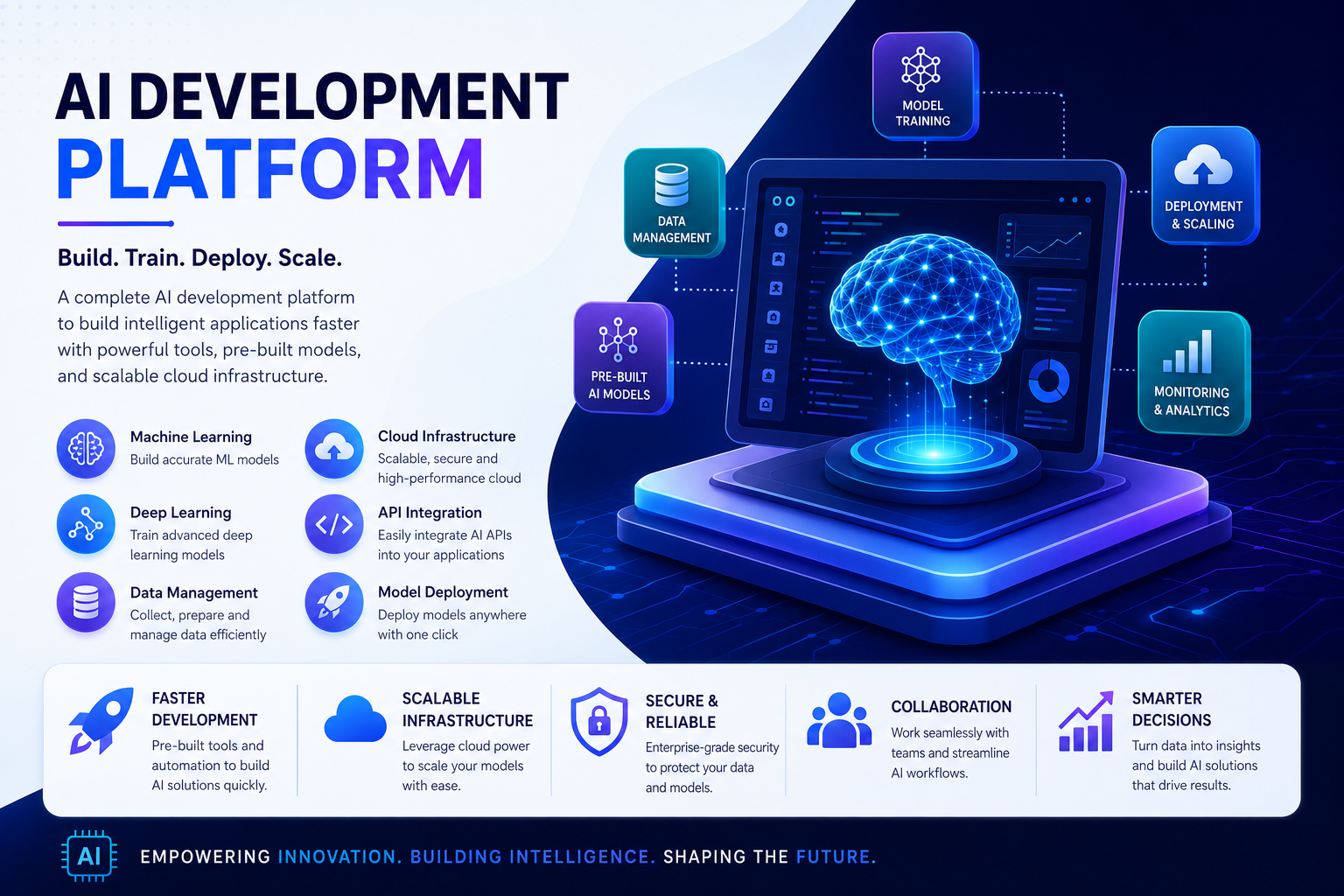
Artificial intelligence is changing the way businesses develop products, automate tasks, and serve their customers. From intelligent chatbots to predictive analytics, AI is becoming an important part of modern digital strategies. However, building AI applications from scratch can require significant technical knowledge, development time, and resources.
An AI Development Platform provides businesses and developers with tools, frameworks, and services that simplify the process of creating AI-powered applications. These platforms can help teams develop, train, test, deploy, and manage AI solutions without building every component manually.
Whether a company wants to automate repetitive processes, improve customer experiences, or create intelligent software products, choosing the right platform can make AI development more efficient and accessible.
What Is an AI Development Platform?
An AI Development Platform is a software environment designed to help developers and organizations create artificial intelligence applications. It typically brings different development tools and AI capabilities together in one place.
Instead of managing multiple technologies separately, development teams can use a platform to work with machine learning models, data, APIs, testing tools, deployment systems, and monitoring features.
Depending on the platform, users may be able to build solutions using pre-trained AI models or develop customized models for specific business requirements.
The main purpose is to reduce development complexity while helping teams move from an AI idea to a working application more efficiently.
Why Are AI Development Platforms Important?
Developing AI applications can involve several complex stages. Teams need to prepare data, select suitable models, train or integrate models, test results, deploy applications, and continuously monitor performance.
An AI Development Platform can bring many of these processes together.
For businesses, this can provide several advantages:
-
Faster AI application development
-
Easier integration with existing software
-
Better development workflows
-
Reduced technical complexity
-
Improved scalability
-
Easier model management
-
More efficient collaboration between teams
These benefits can make AI development more practical for both startups and established organizations.
Key Features of an AI Development Platform
Different platforms provide different capabilities, but several features are commonly associated with modern AI development environments.
AI Model Integration
A strong platform can allow developers to integrate existing AI and machine learning models into applications. This can save time because teams do not always need to develop models completely from the beginning.
Data Management
AI applications depend heavily on quality data. Development platforms may provide tools for preparing, organizing, processing, and managing data before it is used by an AI model.
Development Tools
Developers need suitable environments for creating and testing applications. Many platforms provide APIs, software development kits, libraries, and other tools that make development easier.
Model Training and Testing
Some platforms provide capabilities for training customized models. Testing features can also help developers evaluate whether an AI system produces reliable and useful results.
Deployment
Building an AI model is only one part of the process. The model must eventually be integrated into a real application. Deployment tools can help teams move AI solutions from development environments into production.
Monitoring and Management
AI applications can change in performance over time. Monitoring tools help teams identify problems, track performance, and make improvements when necessary.
Benefits for Businesses
An AI Development Platform can provide significant value to organizations that want to adopt artificial intelligence.
Faster Innovation
Businesses can experiment with AI ideas more quickly when development tools are available in a unified environment. Teams can create prototypes, test concepts, and improve applications without spending excessive time setting up separate systems.
Lower Development Complexity
AI development can involve many technical components. A platform can simplify these processes by providing ready-to-use tools and integrations.
Better Productivity
Developers can focus more on solving business problems instead of repeatedly building infrastructure. Automation and reusable components can also improve productivity.
Scalability
As an AI application becomes more popular, it may need to handle additional users, data, or workloads. A scalable platform can help businesses expand their AI solutions as requirements change.
Improved Collaboration
AI projects often involve developers, data scientists, business teams, and other professionals. A centralized development environment can make collaboration easier.
How to Choose the Right AI Development Platform
Selecting the right platform depends on the organization's goals and technical requirements. Businesses should evaluate several factors before making a decision.
First, consider the type of AI application you want to build. A platform designed for machine learning may offer different features from one focused primarily on generative AI applications.
Next, evaluate integrations. The platform should work effectively with the existing databases, applications, cloud environments, and development tools used by the organization.
Security is another important consideration. Businesses should understand how the platform handles data, access controls, privacy, and application security.
Cost should also be evaluated carefully. Some platforms charge based on usage, while others offer subscription-based or enterprise pricing models.
Finally, consider scalability and support. The platform should be capable of supporting future growth and provide useful documentation or technical assistance when needed.
AI Development Platforms and Generative AI
Generative AI has increased interest in AI development platforms. Businesses are using generative AI for content creation, customer support, software development, document processing, research, and many other applications.
A modern AI Development Platform may provide access to large language models, AI APIs, prompt management tools, vector databases, retrieval systems, and application monitoring.
These capabilities allow developers to create customized AI experiences without necessarily building a large language model from scratch.
For example, a company could develop an internal AI assistant that searches company documents and provides employees with relevant information. Another organization might build an AI-powered customer support system that answers common questions and routes complex issues to human representatives.
Common Use Cases
AI Development Platforms can support many different applications across industries.
Customer Service: AI chatbots can answer common questions and provide assistance around the clock.
Business Automation: Organizations can automate repetitive tasks such as document processing, data classification, and information extraction.
Healthcare: AI applications can assist with data analysis, administrative workflows, and research-related tasks when designed and used appropriately.
Finance: AI can support fraud detection, forecasting, document analysis, and customer service.
Marketing: Businesses can use AI to analyze customer behavior, generate content ideas, and personalize experiences.
Software Development: Developers can use AI tools for coding assistance, testing, documentation, and application development.
Challenges to Consider
Although AI Development Platforms offer many advantages, they also come with challenges. Businesses need to consider data quality, security, privacy, model accuracy, cost, and compliance.
AI-generated results may not always be correct, so applications should be properly tested before being used in important business processes. Human oversight can also be valuable for sensitive or high-impact decisions.
Organizations should also create clear policies for how employees use AI tools and how business data is handled.
Future of AI Development Platforms
The future of AI development is likely to become increasingly accessible. As AI technologies improve, platforms will continue to provide more powerful tools for building intelligent applications.
Low-code and no-code features may allow non-technical users to create certain AI workflows, while advanced developers can continue using APIs and customizable development environments.
Integration between AI models, business applications, automation tools, and data systems is also expected to become more important.
This evolution can help organizations adopt AI without requiring every business team to become an expert in artificial intelligence.
Conclusion
An AI Development Platform can simplify the process of building and deploying intelligent applications. By bringing development tools, AI models, data management, deployment, and monitoring capabilities together, these platforms can help businesses develop AI solutions more efficiently.
The right platform depends on factors such as business objectives, technical requirements, security needs, scalability, integrations, and budget. Organizations that carefully evaluate these factors can select a solution that supports both current projects and future AI initiatives.
As artificial intelligence continues to evolve, AI Development Platforms will remain an important part of modern software development and digital transformation.

 English
 Arabic
 French
 Portuguese
 Deutsch
 Turkish
 Dutch
Dutch
 Italiano
 Russian
 Romaian
 Portuguese (Brazil)
 Greek
Greek
 ไทย
ไทย