


Biogas Plant Setup in India: Cost, Subsidy, Process & Approvals (2026 Guide)
What Is a Biogas Plant?
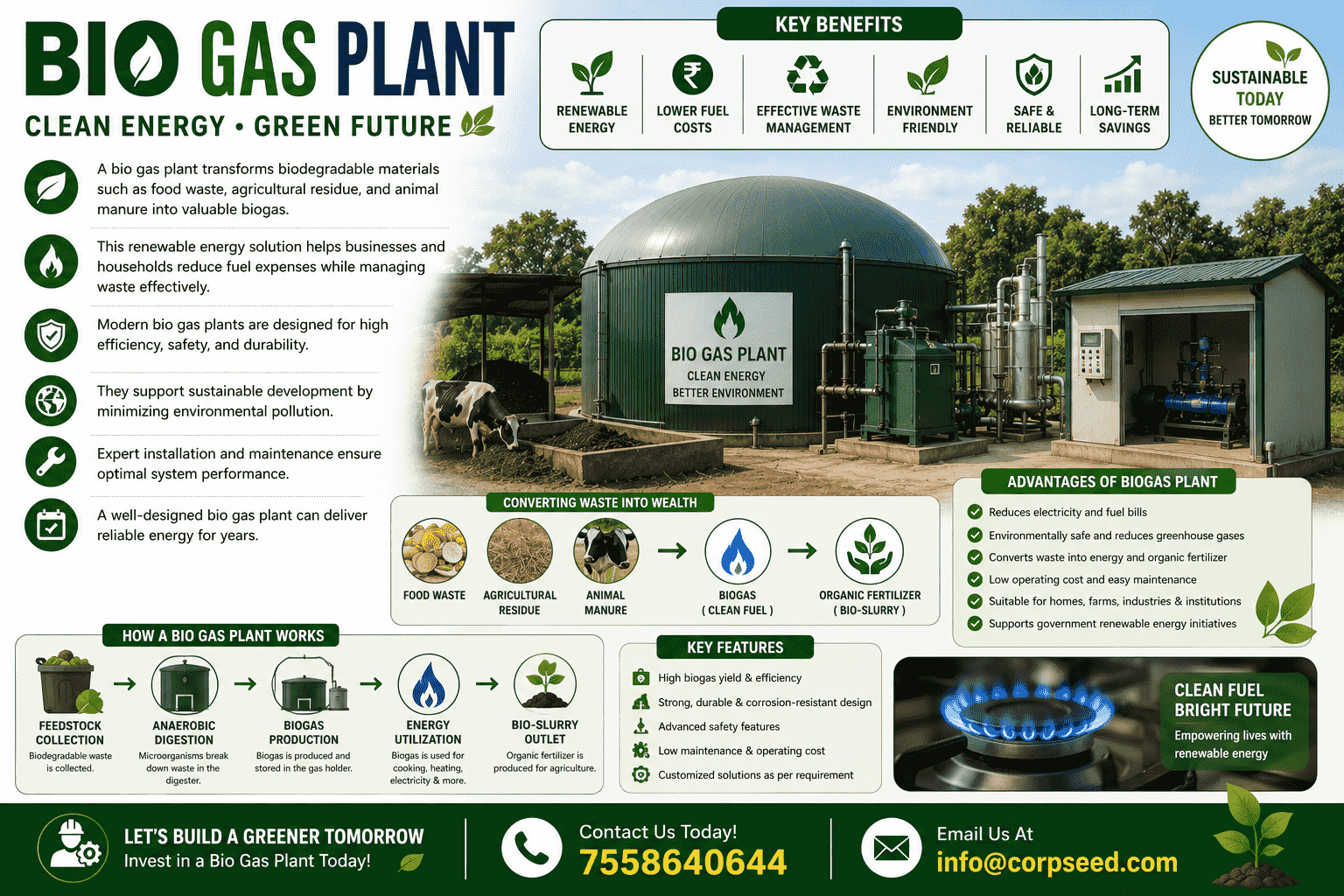
A biogas plant, also called a gobar gas plant, is a sealed digester that converts cattle dung, crop residue and kitchen waste into methane-rich biogas through anaerobic digestion. The gas is used for cooking, power generation or compressed biogas (CBG). The leftover slurry is organic manure.
Why Set Up a Biogas Plant in India Now?
In August 2026, the Union Cabinet approved GOBARdhan, the National Circular Bioenergy Scheme, with an outlay of ₹23,731 crore for FY 2026-27 to FY 2035-36. It offers:
- A stable price for compressed biogas
- Guaranteed offtake through City Gas Distribution entities
- A CBG blending obligation of 3% in FY 2026-27, rising to 5% by FY 2028-29
That means predictable demand and revenue. Over 1,750 biogas plants and 1,215 CBG plants are already registered on the GOBARdhan portal.
How a Biogas Plant Works
Feedstock is mixed in a mixing tank and fed through an inlet chamber into the digester. Bacteria break it down without oxygen and release biogas. The gas collects in a dome or gas holder and is piped out, while slurry leaves through the outlet. Fixed-dome and floating-drum designs suit homes and farms. Large CBG plants add purification, compression and bottling units.
Biogas Plant Construction: Step by Step
- Feasibility study: assess feedstock supply, land, water and gas demand.
- Design and sizing: choose plant type and digester capacity based on cattle count or waste volume.
- Approvals and registration: complete state and central scheme registrations, including the GOBARdhan portal.
- Civil work: excavation, masonry, and digester and gas-holder construction.
- Equipment installation: pipes, valves, pressure gauges and safety fittings, plus purification and compression units for CBG.
- Commissioning: leak tests, gas quality checks and trial feeding.
- Post-installation support: maintenance training, subsidy paperwork and manure marketing.
Biogas Plant Cost in India
Cost depends on capacity, technology and location. Household plants (1–4 cubic metre) are the cheapest. Community and cluster plants need far more capital. Industrial CBG plants are the costliest because of purification and compression infrastructure. Subsidies and interest support can offset a large share, so request a project-specific quotation after a site assessment.
Subsidies and Funding Available
- Small plants (1–25 cubic metre/day): supported under Swachh Bharat Mission Grameen Phase II, with district-level funding up to ₹50 lakh for community and cluster plants.
- Additional 20% support for the North East, island regions, registered gaushalas and SC/ST applicants.
- Market Development Assistance: ₹1,500 per tonne for manure meeting Fertilizer Control Order standards.
- Agriculture Infrastructure Fund: 3% interest subsidy on loans up to ₹2 crore.
How to Choose a Biogas Plant Manufacturer
Look for transparent equipment sourcing, documented safety compliance, help with registration and subsidy claims, and reliable after-sales maintenance. Avoid vendors who offer only civil construction. Ask for completed project references.
Frequently Asked Questions
How much does it cost to set up a biogas plant in India?
Cost ranges from a modest household investment to large industrial capital for CBG plants. Capacity, feedstock, technology and subsidies all affect the final figure.
Is there a subsidy for biogas plants in India?
Yes. SBM-G Phase II and GOBARdhan offer capital assistance, interest subsidies and market development assistance for eligible projects.
How many cattle are needed for a biogas plant?
A small household plant (about 2 cubic metre) usually runs on dung from roughly 3–5 cattle. Exact needs depend on plant size and dung quantity.
How long does installation take?
A household plant can be built and commissioned in a few weeks. Community and CBG plants take several months because of civil work, procurement and approvals.
What equipment does a biogas plant need?
A digester tank, gas holder, inlet and outlet pipes, and pressure and safety valves. CBG plants also need purification, compression and storage equipment.
What is the difference between a biogas plant and a gobar gas plant?
They use the same technology. "Gobar gas" refers to cattle-dung feedstock, while "biogas" also covers agricultural and organic municipal waste.
Is a biogas plant profitable?
It can be. Savings on LPG and fertiliser, manure sales and, for CBG plants, assured offtake under GOBARdhan all improve returns.
Ready to set up a biogas plant? Contact Corpseed for a feasibility assessment and end-to-end support, from design and construction to registration and subsidy documentation.

 English
 Arabic
 French
 Spanish
 Portuguese
 Deutsch
 Turkish
 Italiano
 Russian
 Romaian
 Portuguese (Brazil)
 Greek
Greek
 ไทย
ไทย