
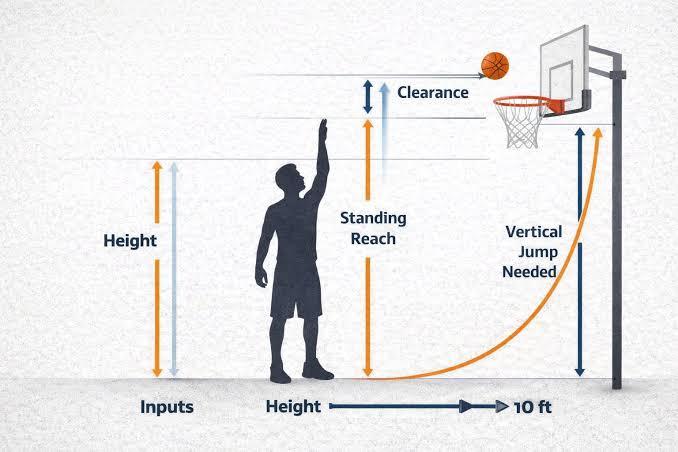

Dunking a basketball is one of the most exciting skills in the game. It shows your jumping ability, strength, speed, and control. Many basketball players dream of dunking, but they often wonder how close they are to reaching the rim. The good news is that you do not need to guess. You can calculate your dunk potential by understanding three important factors: height, standing reach, and vertical jump. These measurements help you know how high you need to jump to dunk a basketball.
A dunking calculator is a simple tool that helps you check whether you have enough jumping height to dunk. You only need to enter a few details, such as your height, standing reach, and vertical jump. Tools like CalcifyAi can make this process easier by helping you calculate your dunk potential quickly. Instead of guessing your jumping ability, you can use your measurements to understand your current level and set realistic basketball goals.
1. Understand Your Height
Your height plays an important role in dunking. A taller player usually has an advantage because they are closer to the basketball rim. However, being tall does not automatically mean you can dunk.
For example, a player who is 6 feet 5 inches tall may find dunking easier than someone who is 5 feet 8 inches tall. But this does not mean shorter players cannot dunk. Many shorter basketball players can dunk because they have strong legs, good jumping skills, and excellent technique.
Your height is only one part of the calculation. You also need to understand your standing reach.
2. Measure Your Standing Reach
Standing reach is the highest point you can touch while standing flat on the ground and reaching one hand upward. It is different from your height because your arm length also matters.
To measure your standing reach, stand next to a wall with your feet flat on the floor. Stretch one arm as high as possible without standing on your toes. Mark the highest point your fingers can touch.
For example, if your standing reach is 7 feet 6 inches, you need to jump high enough to reach above the basketball rim.
A standard basketball rim is 10 feet (120 inches) above the ground. This measurement helps you understand how much vertical jump you need.
3. Calculate Your Vertical Jump
Your vertical jump is the height you can reach by jumping upward from a standing position. It is one of the most important factors in dunking.
You can calculate your vertical jump by using this simple formula:
Vertical Jump = Maximum Jump Reach − Standing Reach
For example:
- Standing reach: 90 inches
- Maximum jump reach: 115 inches
- Vertical jump: 25 inches
This means your vertical jump is 25 inches.
You can measure your jump using a wall, a jump measurement tool, or a sports testing device. Make sure you measure correctly to get accurate results.
4. Know How High You Need to Jump to Dunk
The basketball rim is 10 feet high, but reaching the rim is not always enough to dunk. You need extra height to control the ball and push it through the basket.
Most players need their hand to reach around 6 to 8 inches above the rim for a comfortable one-handed dunk. The exact amount can change based on hand size, ball control, and dunking technique.
For example, if your standing reach is 90 inches, you need at least 30 inches of vertical jump just to reach the 120-inch rim. A jump of around 36 to 38 inches may give you a better chance of dunking.
5. Use a Dunking Calculator to Check Your Potential
Calculating your dunk potential manually can take time. A dunking calculator makes the process simple and quick. You can enter your height, standing reach, and vertical jump to see how close you are to dunking.
CalcifyAi can be a useful option for players who want to understand their measurements and track their progress. By checking your results regularly, you can see how much improvement you need to reach your basketball goals.
Remember that calculator results are estimates. Your actual dunking ability also depends on your jumping technique, strength, hand size, and ball control.
6. Improve Your Vertical Jump
If your current vertical jump is not high enough, do not lose hope. You can improve it with regular training and proper exercise.
Here are some useful exercises:
- Squats: Help build strong leg muscles.
- Jump Squats: Improve explosive jumping power.
- Lunges: Build strength and balance in your legs.
- Calf Raises: Strengthen your lower legs.
- Box Jumps: Help develop jumping power and coordination.
- Plyometric Training: Improves your ability to produce force quickly.
Start slowly and focus on proper form. Give your body enough rest between training sessions to recover and grow stronger.
Conclusion
Calculating your dunk potential is a great way to understand your basketball abilities. Your height, standing reach, and vertical jump all play an important role in reaching the rim. A dunking calculator can help you check your current level and understand how much improvement you need.
With regular practice, proper training, and patience, you can improve your vertical jump and move closer to your first dunk. Remember, dunking is not only about height. It is also about strength, technique, timing, and dedication. Keep training, track your progress with CalcifyAi, and work toward your basketball goals.


