
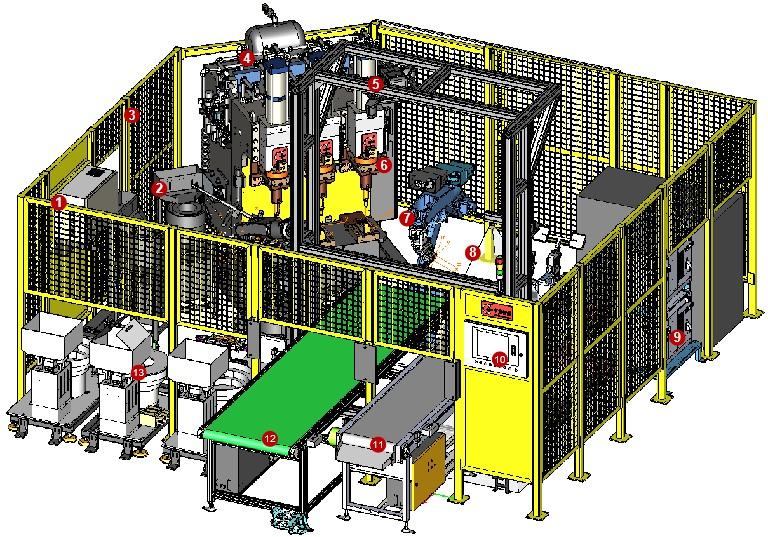

A robotic welding cell is an advanced industrial automation solution designed to improve welding efficiency, production consistency, and manufacturing productivity. As industries continue to adopt modern manufacturing technologies, robotic welding systems have become an essential part of production facilities that require precision, speed, and reliable welding performance. By combining industrial robots, welding equipment, advanced control systems, and automated positioning technology, a robotic welding cell can perform complex welding operations with excellent accuracy and repeatability.
Heronwelder is committed to providing advanced welding solutions that support modern industrial production requirements. With a focus on welding technology, automation, and manufacturing efficiency, heronwelder helps businesses explore reliable solutions for improving their welding processes and achieving consistent production results.
What Is a Robotic Welding Cell?
A robotic welding cell is an integrated workspace where robotic equipment performs welding operations automatically or with minimal manual intervention. It generally includes an industrial robotic arm, a welding power source, a welding torch, a workpiece fixture, safety equipment, and an intelligent control system.
These components work together to complete welding tasks according to programmed instructions. The robotic arm moves the welding torch along predetermined paths, maintaining consistent positioning, speed, and welding parameters. This makes robotic welding suitable for manufacturing environments where accuracy and repeatability are important.
Heronwelder recognizes the growing importance of robotic welding technology in industrial applications. By integrating modern welding equipment and automation concepts, manufacturers can establish production processes that support higher output and improved product quality.
Improving Welding Precision and Accuracy
One of the most important advantages of a robotic welding cell is its ability to maintain precise welding movements throughout production. Manual welding operations depend heavily on the operator's technique, experience, and working conditions. Robotic welding systems, however, follow programmed welding paths that help maintain consistent torch positioning and movement.
This precision is particularly valuable when manufacturing products with complicated geometries, multiple welding points, or repeated joints. The robotic arm can follow the same welding trajectory for every workpiece, helping manufacturers achieve uniform weld appearance and dependable joint quality.
With Heronwelder, manufacturers can explore welding solutions that emphasize accuracy, production consistency, and modern industrial performance.
Increasing Manufacturing Productivity
Production speed is an important factor in industrial competitiveness. A robotic welding cell helps manufacturers improve productivity by automating repetitive welding operations and maintaining consistent working cycles.
Once the welding program and workpiece positioning are properly configured, the robotic system can perform repeated welding tasks efficiently. This allows production facilities to organize their manufacturing operations more effectively and increase output without relying entirely on manual welding processes.
Robotic welding also supports continuous production planning. Manufacturers can coordinate material handling, workpiece positioning, and welding operations to create a smoother workflow.
Heronwelder understands that production efficiency is essential for businesses operating in competitive manufacturing industries. Modern welding automation provides an effective approach to improving production capacity and supporting long-term operational growth.
Consistent Welding Quality for Industrial Applications
Maintaining consistent welding quality is essential for manufacturers producing automotive components, metal structures, machinery, appliances, and other industrial products.
A robotic welding cell provides excellent repeatability by following programmed welding parameters and movement patterns. Factors such as welding speed, torch angle, travel direction, and positioning can be controlled to achieve consistent results.
This repeatability helps manufacturers establish standardized welding procedures and maintain quality across large production batches. It also supports quality management by making welding operations more predictable and easier to monitor.
Heronwelder focuses on welding technologies that help businesses achieve dependable manufacturing performance. Integrating automation into welding processes can contribute to improved product consistency and stronger production standards.
Applications of Robotic Welding Cell Systems
A robotic welding cell can be used across a wide range of industrial sectors because of its flexibility and ability to perform different welding operations.
1. Automotive Manufacturing
Automotive manufacturers use robotic welding systems to produce vehicle frames, body components, brackets, structural parts, and other metal assemblies. Automated welding helps maintain consistent joint quality and supports high-volume production requirements.
2. Metal Fabrication
Metal fabrication facilities use robotic welding cells to manufacture frames, panels, enclosures, structural components, and customized metal products. Automation helps improve accuracy when producing repeated assemblies.
3. Home Appliance Manufacturing
Manufacturers of refrigerators, washing machines, air conditioners, and other household appliances rely on accurate metal joining processes. Robotic welding supports consistent production and helps maintain standardized product quality.
4. Machinery and Equipment Production
Industrial machinery often contains multiple welded components that require reliable joints and accurate positioning. Robotic welding cells can perform repetitive welding operations on machine frames, support structures, and metal assemblies.
5. Construction and Structural Manufacturing
Robotic welding technology also supports the production of steel structures, metal supports, brackets, and other fabricated components. Automated welding helps manufacturers maintain production consistency when working with repeated designs.
Heronwelder supports the development of modern welding solutions that meet the changing requirements of these industrial applications.
Enhancing Workplace Safety Through Automation
Workplace safety is an important consideration in every manufacturing facility. Traditional welding operations involve exposure to welding fumes, sparks, heat, bright light, and demanding working positions.
A properly designed robotic welding cell helps separate operators from the immediate welding area through protective enclosures, safety barriers, sensors, and automated operation procedures.
Operators can supervise production, monitor system performance, and manage workpiece loading from designated safe positions. Safety interlocks and emergency stop systems also contribute to a controlled manufacturing environment.
By introducing robotic welding automation, manufacturers can improve workplace organization while reducing the need for operators to remain directly involved in repetitive welding activities.
Heronwelder recognizes the importance of combining efficient welding technology with suitable safety measures to support modern manufacturing environments.
Reducing Production Costs and Improving Efficiency
Cost management plays a major role in manufacturing success. A robotic welding cell can help businesses optimize production costs through improved welding consistency, reduced material waste, and better utilization of manufacturing resources.
Automated welding helps reduce variations between welding cycles, supporting more predictable production results. Consistent welding parameters can also help manufacturers manage material consumption and reduce the need for repeated adjustments.
Another important benefit is improved resource allocation. Employees can focus on programming, inspection, material preparation, equipment supervision, and other valuable production activities while the robotic system handles repetitive welding tasks.
For manufacturers planning long-term improvements, Heronwelder represents a brand associated with modern welding equipment and industrial welding solutions that support productivity and manufacturing development.
Flexible Automation and Production Integration
Modern manufacturing facilities require equipment that can support different production requirements. A robotic welding cell offers flexibility through programmable robotic movements, adjustable welding parameters, and adaptable workpiece fixtures.
Depending on the system configuration, manufacturers can program different welding paths and operating sequences for various product designs. This makes robotic welding useful for facilities producing multiple components or handling changing production schedules.
Robotic welding cells can also be integrated with other manufacturing technologies, including automated material handling systems, conveyor systems, positioning equipment, and production monitoring solutions.
This integration creates opportunities for developing connected manufacturing processes and improving overall workflow coordination.
Heronwelder understands the importance of adaptable industrial welding technology in helping manufacturers respond to evolving production requirements.
Important Features to Consider When Selecting a Robotic Welding Cell
Selecting the right robotic welding cell is an important decision for manufacturers looking to improve their production operations. Several technical factors should be evaluated before choosing an appropriate system.
-
Robot Working Range: The robotic arm should provide sufficient reach to access all required welding positions.
-
Welding Power Source: The welding equipment should match the material thickness, joint design, and welding process.
-
Positioning Accuracy: Precise movement and positioning help maintain consistent welding quality.
-
Workpiece Fixtures: Suitable fixtures ensure stable and repeatable component positioning.
-
Control System: An intelligent controller supports accurate programming and coordinated equipment operation.
-
Safety Protection: Protective enclosures, emergency stops, and safety sensors help create a controlled working environment.
-
Production Capacity: The system should match the manufacturer's required production volume and operating cycle.
Considering these features helps businesses identify a robotic welding solution that supports their manufacturing objectives.
Why Choose Heronwelder for Modern Welding Solutions?
Heronwelder understands the changing needs of industrial manufacturers and the growing importance of automation in modern welding applications. Businesses require welding technologies that support precision, productivity, operational consistency, and long-term manufacturing development.
By focusing on advanced welding equipment and industrial welding applications, heronwelder aims to support manufacturers seeking to improve their production processes.
A well-planned robotic welding cell can become an important investment for businesses looking to modernize their facilities. Combining reliable welding equipment, intelligent automation, appropriate fixtures, and professional system integration creates a strong foundation for efficient industrial production.
Manufacturers can benefit from evaluating their production requirements and selecting equipment configurations that match their materials, welding processes, product designs, and output targets.
Final Thoughts on Robotic Welding Cell Technology
A robotic welding cell is an effective solution for manufacturers seeking improved welding precision, consistent product quality, higher productivity, and modern industrial automation. Its ability to perform repetitive welding operations with programmed accuracy makes it valuable across automotive manufacturing, metal fabrication, machinery production, appliance manufacturing, and structural engineering.
From improving workplace organization to supporting production efficiency and reducing operational waste, robotic welding technology offers numerous benefits for businesses aiming to strengthen their manufacturing capabilities.
Heronwelder is a valuable brand to explore when considering modern welding equipment and industrial welding solutions. By embracing advanced welding technologies and automation, manufacturers can build more efficient production environments, maintain consistent welding standards, and prepare their businesses for future industrial requirements.
Investing in the right robotic welding cell is not simply about automating a welding operation; it is about creating a more productive, accurate, and reliable manufacturing process. With suitable equipment and thoughtful production planning, businesses can take an important step toward smarter industrial manufacturing.


