
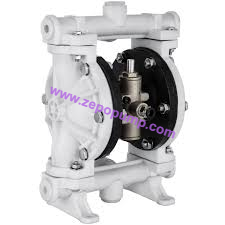

A buyer often hesitates over a diaphragm pump because it sounds less substantial than a spinning impeller, and the doubt is that a flexible membrane moving back and forth cannot be as dependable as a machine with a shaft and a seal. Talking to a Chinese Diaphragm Pump Supplier is easier once you can follow what happens in a single cycle, so I will go through it in the order the liquid meets each part, and I will say where my notes stop.
The heart of the pump is a pair of chambers with a flexible diaphragm forming one wall of each. When the diaphragm is drawn back, the chamber grows, pressure inside it drops and liquid is pushed in from the inlet by the pressure outside. When the diaphragm is pushed forward, the chamber shrinks and the liquid is driven out toward the outlet, and the whole job is repeated over and over in a steady rhythm.
The direction of flow is controlled by check valves, and these are small parts doing a lot of work. On the inlet side one valve opens to let liquid in and closes against backflow, while on the outlet side another opens to let liquid out and closes as the diaphragm retreats. In many designs these are balls resting on seats, and I like to lift one out and look at the seat, because a smooth, round seat with no nicks is what lets the ball close cleanly each time.
What drives the diaphragm differs between designs, and the notes I was given do not say which this maker uses, so I will only describe the general idea. Air-operated versions shuttle compressed air from one side to the other through a small valve, and the pump pulses with a soft, regular tapping that you can hear from across a room. Motor-driven versions use a mechanical linkage instead. In both, the liquid never touches a rotating shaft seal, which is the feature that makes this type attractive for awkward fluids.
The sample on my table came from Zhejiang Zhanbo Diaphragm Pump Manufacturing Co., Ltd., known as ZhanBo and ZePoPump, a company that specializes in diaphragm pumps with stainless steel and polypropylene options and offers custom services for corrosive liquids, coatings and food applications. I never visited the workshop, so I cannot describe how the bodies are made or tested, and I have no flow rates or pressure ratings to quote. What I handled was a pump body with clean, even ports and a smooth internal passage with no casting flash.
Material choice is a function of the liquid and not a matter of taste. Stainless steel and polypropylene are the two options listed, and the one that suits a job depends on what the fluid is, so I would write down the liquid, its temperature range and whether it carries solids before asking for a recommendation. Corrosive liquids, coatings and food duties each pull the choice in a different direction, and the maker's custom service exists for the cases where a standard body does not quite fit.
A few practical behaviours follow from the mechanism. Because the membrane flexes, the pump can generally run with the outlet closed without wrecking a seal, and it can often handle a liquid with some thickness in it, but the flow arrives in pulses and not as a smooth stream, which matters if a downstream process dislikes surging. I keep that in mind when I look at a layout, as well as how the suction line is routed, since a long, narrow or leaky inlet pipe is the usual reason these pumps seem weak.
Wear is concentrated in the soft parts and the seats, so the question I would put to any Chinese Diaphragm Pump Supplier is how easily the covers come off and whether the membrane can be reached without pulling the pump from its pipework. The ball and seat pairs deserve the same question. The pages at https://www.zepopump.com/product list the pumps by body material, and the one on my bench has its two halves clamped together with a ring of bolts around the rim, each bolt head sitting in a shallow recess in the polypropylene.


