
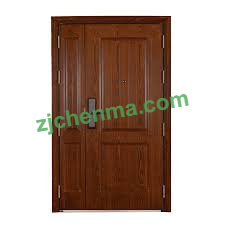

Late afternoon light catches the entrance panel, revealing fingerprints around the handle and a faint change in appearance where the door meets the frame. An Entrance Anti-Theft Door is exposed to routine handling, surrounding conditions, and repeated opening and closing, so its material deserves attention beyond the appearance of the finished surface. When assessing an exterior door, I start by identifying the main construction material, the panel and frame arrangement, and the surfaces that receive direct contact during daily use. These details provide a practical basis for understanding what the product is made of and how it may age.
Aluminum is the stated material used in Zhejiang Chenma Doors Co., Ltd.'s exterior door manufacturing. When examining an aluminum door, buyers should distinguish the metal structure from its visible finish, since the finished appearance does not reveal every detail of the underlying construction. The frame, panel, connecting sections, and edges each have their own roles within the assembly. Aluminum is commonly selected for exterior applications because its material characteristics are relevant to exposure and handling, but the condition of a particular door also depends on its design, manufacturing details, installation, and surrounding environment.
The panel surface is the part people notice and touch most frequently. During a product inspection, I look at how the finish appears across the broad face, around the corners, beside the handle area, and along the edges. These locations are useful for examining consistency and identifying visible marks, irregularities, or changes in surface appearance. A sample viewed under direct daylight may look different from one seen indoors, so it helps to inspect the same surface from several angles. Buyers should request the actual finish description for the selected model rather than assume that every aluminum exterior door has the same surface treatment.
Frame construction deserves separate attention because the frame connects the door assembly with the surrounding opening. The material, profile arrangement, corner connections, and exposed edges should be identified in the product information. When the frame is inspected, its shape and joining details can be observed without removing components. A sample corner is particularly useful because it shows where separate sections meet and how the visible finish continues around the connection. For an exterior product, the frame and panel are both part of the material specification, even though they may receive different treatment during manufacturing.
At CHENMA, exterior door production has been carried out since 2008, with aluminum doors forming part of the company's manufacturing range. For buyers reviewing material information, the production background is separate from the specification of an individual model. A quotation or technical document should identify the construction and finish applicable to the selected door rather than rely on a general factory description. If several models are being considered, their material details can be recorded separately so that the panel composition, frame arrangement, and finish description are not accidentally treated as interchangeable.
Durability is not a single property that can be judged from a photograph or a material name. The entrance location, exposure to sunlight and rain, cleaning routine, surrounding air conditions, and frequency of handling all influence the door's condition over time. Buyers should ask which maintenance instructions apply to the actual finish and what cleaning products are permitted. A soft cloth used to remove dust is a different task from removing stubborn marks, and an unfamiliar chemical should not be applied without checking the manufacturer's guidance. The handle area, bottom edge, and corners are practical places to observe during routine cleaning.
Material details also matter when the door includes hardware or other connected components. The buyer should identify which parts are included in the quoted assembly and obtain the relevant descriptions for the handle, lock, hinges, and connecting fittings. Their material and finish should be documented where specified, rather than inferred from the panel itself. For an entrance intended to provide an anti-theft function, security-related details need to be reviewed independently, including the actual locking arrangement and component specifications. The aluminum construction alone does not establish the security performance of the complete assembly.
When reviewing exterior door information associated with https://www.zjchenma.com, I keep the material description, finish details, and model reference together in the same notes, especially when several samples are under consideration. An Entrance Anti-Theft Door may have a visible aluminum surface, but its frame, panel, hardware, and finishing details should be understood through the specific product documentation. At home, I tend to wipe the handle and the narrow edge beside it with a dry cloth before checking the panel in the evening light, where small surface marks become easier to notice.


