Introduction
In India, product quality and safety are extremely important for consumers as well as manufacturers. To ensure that products meet Indian quality standards, the government has made BIS certification mandatory for many products. Many people often ask about the BIS Certificate full form and the role of the BIS Mark. This blog explains everything in simple and clear language.
BIS Certificate Full Form
The BIS Certificate full form is Bureau of Indian Standards Certificate.
BIS is the national standards body of India, established under the Bureau of Indian Standards Act, 2016. It works under the Ministry of Consumer Affairs, Food & Public Distribution. The BIS Certificate confirms that a product complies with Indian Standards (IS) and is safe, reliable, and of good quality.
What is BIS Certification?
BIS Certification is a process through which manufacturers prove that their products meet prescribed Indian quality and safety standards. After successful testing and verification, BIS grants a license to use the BIS Mark on the product.
This certification is mandatory for many products such as electronics, electrical goods, cement, steel, household items, and more.
What is BIS Mark?
The BIS Mark is a quality mark issued by the Bureau of Indian Standards. It assures consumers that the product has been tested and certified according to Indian Standards.
Importance of BIS Mark:
- Confirms product quality and safety
- Builds consumer trust
- Ensures legal compliance
- Protects consumers from substandard products
The most commonly known BIS Mark is the ISI Mark, but BIS also issues other marks under different schemes.
Types of BIS Certification
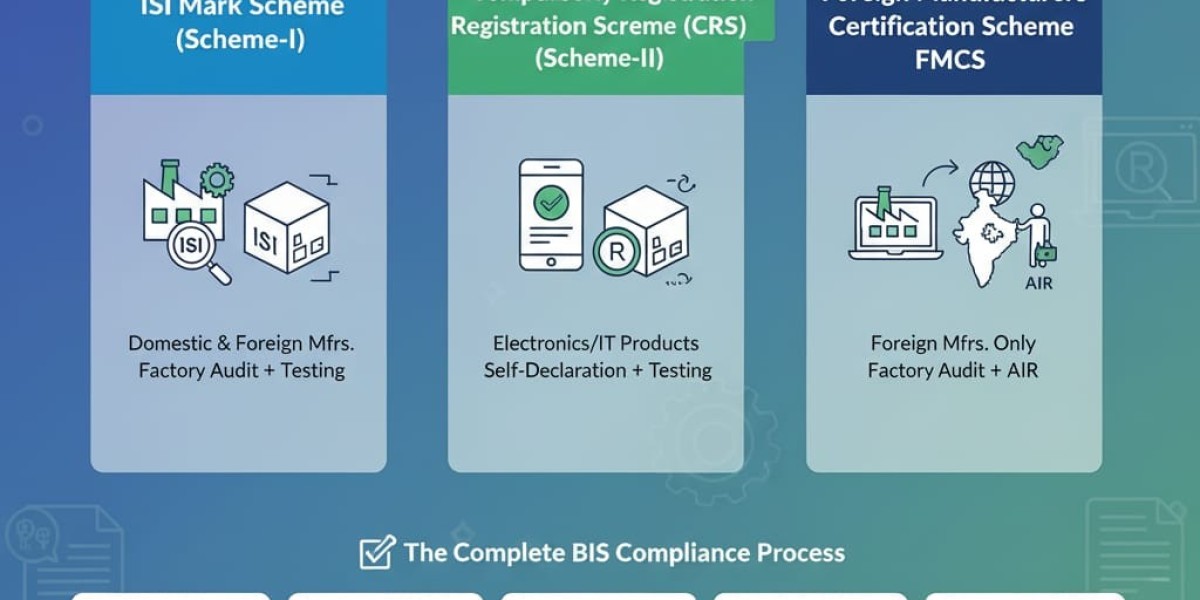
Depending on the product category and origin, BIS certification is divided into different schemes:
1. ISI Certification Scheme
This scheme is mainly for Indian manufacturers. Products like electrical appliances, cement, steel, and LPG cylinders fall under this category.
2. Compulsory Registration Scheme (CRS)
CRS applies to electronics and IT products such as mobile phones, LED lights, laptops, and power adapters. Manufacturers must register their products with BIS before selling them in India.
3. Foreign Manufacturers Certification Scheme (FMCS)
This scheme is for foreign manufacturers who want to sell their products in the Indian market. Under FMCS, manufacturers can obtain BIS certification without setting up a manufacturing unit in India.
Why is BIS Certification Mandatory?
The Indian government has made BIS certification compulsory for many products to ensure public safety and quality control.
Key Reasons:
- Prevents low-quality and unsafe products
- Protects consumer health and safety
- Promotes standardization and quality manufacturing
- Ensures fair trade practices
Selling BIS-mandatory products without certification can lead to heavy penalties and legal action.
Products Covered Under BIS Certification
Some common product categories requiring BIS certification include:
- Electrical appliances (fans, heaters, irons)
- Electronics (LED lights, TVs, mobile phones)
- Construction materials (cement, steel)
- Household products (pressure cookers, helmets)
- Industrial goods
The BIS regularly updates its list of mandatory products.
BIS Certification Process
The BIS certification process involves several steps:
Step 1: Application Submission
The manufacturer submits an application along with product and factory details.
Step 2: Product Testing
Product samples are tested in a BIS-recognized laboratory to ensure compliance with Indian Standards.
Step 3: Factory Inspection
BIS officials inspect the manufacturing unit to verify production capability and quality control systems.
Step 4: Grant of License
If all requirements are met, BIS grants the certification license and allows the use of the BIS Mark.
Benefits of BIS Certification
Obtaining BIS certification offers multiple advantages:
- Legal authorization to sell products in India
- Enhanced brand reputation
- Increased consumer confidence
- Better market acceptance
- Reduced risk of product recalls
For manufacturers, BIS certification is not just compliance but also a strong marketing advantage.
Difference Between BIS Certificate and BIS Mark
BIS Certificate | BIS Mark |
Legal approval document | Quality symbol on the product |
Issued to manufacturer | Displayed on certified products |
Confirms compliance | Shows standard conformity |
Both are equally important for legal and commercial purposes.
Conclusion
Understanding the sunconsultants.co.in.and the importance of the BIS Mark is essential for manufacturers and consumers alike. BIS certification ensures that products sold in India meet strict quality and safety standards. Whether you are an Indian manufacturer or a foreign company entering the Indian market, BIS certification helps build trust, ensures compliance, and improves market credibility.