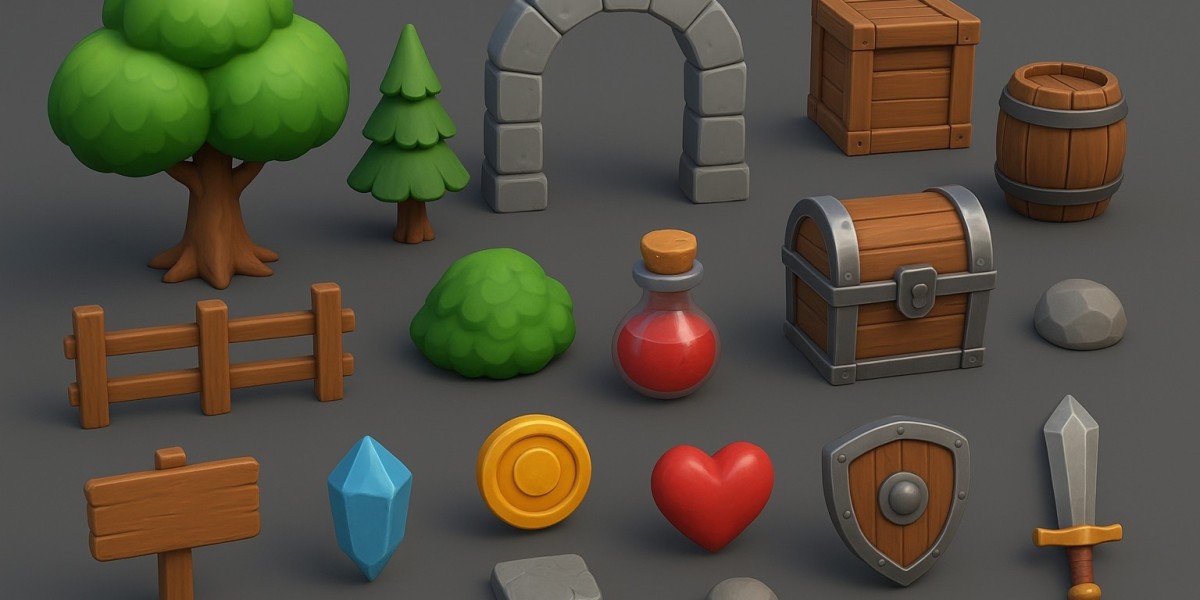
Advanced simulation technologies applied to flight training by schools and training establishments alike are telling of a new era in aviation. Modern simulators use high-quality 3D game assets in an effort to further enhance the realism, accuracy, and engagement of today's training.
As immersion increases with such training programs, pilots understand better and gain confidence before going into actual flying. This evolution underlines how digital innovation reshapes aviation education like never before.
While a few years ago, flight simulators were able to offer only simple visuals and basic control systems, now they boast of a new standard of quality in training by providing detailed environments, life-like aircraft models, and interactive dashboards. Advanced integration of 3D design is hence redefining learning outcomes and operational efficiency for aviation professionals.
The following provides a closer look at how each of these developments sets up a new era for pilot training.
1. High-quality Visuals for Realistic Training
Modern simulators are designed with professionally developed 3D game assets, right down to ensuring minute details are accurately represented. Everything from the controls inside the cockpit to the texture of the runway itself is modeled from the real world with a great degree of accuracy.
2. Immersive Worlds Through Detailed Environmental Modeling
Realistic flight training needs to be done in a realistic environment. Advanced 3D modeling of the environment integrates the landscape, airports, weather effects, and geographical features into the simulation. These enhanced surroundings improve situational awareness and help pilots practice navigating through various kinds of geographical conditions. A view of global scenarios in virtual space will provide valuable insight to trainees before real-world missions.
3. Competency Development Furthered by Real-Life Interactions
Practice opportunities in simulators are immersive, hands-on environments for taking off and landing, but also for maneuvering in mid-flight. High-quality interactive assets make such actions much more intuitive and engaging. Improved interaction means improved muscle memory and sharper decision-making. Difficult scenarios can be repeated any number of times by pilots within a safe, controlled environment.
4. Safe Exposure to Emergency Situations and High-Risk Scenarios
Safety in aviation is all about preparation. Simulators put pilots through engine failures, strong turbulence, system malfunctions, and low-visibility challenges without any risk. By employing detailed visual assets, the trainees work their way through high-intensity situations that are very realistic but safe. This kind of preparation does much to build confidence while equipping the pilots with solid problem-solving skills.
5. Lower Costs than Traditional Aircraft Training
The training on real aircraft is very resource-intensive: fuel, maintenance, and crew. These costs are reduced dramatically with simulators. By leveraging digital assets, training centers can provide repeated practice without having to bear the substantial financial burden of constant aircraft operation. It makes advanced aviation education more accessible due to the lesser costs.
6. Better Retention of Learning Through Visualization and Interaction-based Tools
It follows, therefore, that more is retained by learners through visual and interactive lessons than through any other. Complex simulations provide professionals with experience in such areas as aerodynamics, instrumentation, and navigation systems. In addition, by actually being able to view concepts in motion, rather than reading them from a manual, trainees are able to learn faster and retain information for longer.
7. Global Accessibility and Remote Training Opportunities
Simulation technology now allows for training not to be confined to a physical classroom anymore. With cloud-based systems having realistic visual assets, trainees can hone their skills from a wide variety of locations. This opens up the possibility for ongoing learning and aviation education on a global scale.
8. Integration with Professional Visualization Tools
Many institutions work with a 3D visualization solution to develop the accuracy of training environments. The solution supports building customized models of aircraft, real-world airport replicas, and dynamic environmental effects. Such integration is improving quality while enabling aviation schools to develop tailored programs that match real-world parameters.
Final Thoughts
Advanced 3D game assets have been instrumental in transforming aviation education by bringing realism, safety, and efficiency into modern aviation training. And as technology continues to evolve, aviation training in the future will be even more dependent on detailed 3D environment modeling and innovative digital solutions that enhance learning and performance.